

Of Lice and Men: Dignity and Dehumanizationin the Language of Slovak Politics
Introduction
Arguably, dignity rests at the core of most, if not all, modern political issues. Movements for the equality of racial, religious, or sexual minorities present themselves as the most obvious example of politics splitting on the anvil of dignity (Fukuyama, 2018). However, the same goes for the economy, too. When parliaments debate systems of pensions, distribution of taxes, social welfare, or developments in demography, the underlying question of all such discussions is “who gets what and why?”. The notions of worth and merit are inherently present. The discourse around migration revolves around dignity as well — the calling of the dislocated and uprooted for a decent life among strangers versus the supposed security and cultural integrity of domestic populations. Likewise, technological progress provokes claims to dignity. For instance, artificial intelligence places the living standard of employees who it could substitute at risk, and green transformation asks society at large to decide if the comfort of the living is more, or less important than that of those not yet born. That all these topics are a political matter is without dispute, and because dignity rests at their core, today, dignity itself is a political matter. This study rests on the credible assumption that politics is a conflict between distinguishable groups determined to defeat each other even to their own detriment. Carl Schmitt (1932/2007), the Crown Jurist of the Third Reich, delineated politics as anything that cleaves people into friends and enemies, a split defined by Schmitt as the most extreme expression of human association or dissociation. In other words, to Schmitt, politics is a conflict that begins with identifying the enemy. Decades later, social psychologist and holocaust survivor Henry Tajfel (1970; 1982) explored the fruits of Schmitt’s (1932/2007) paradigm in the notorious us/them experiments, suggesting that humans innately organize themselves into groups based on even arbitrary identifiers and, if competing for the same goal, are ready to abandon the path of cooperation and hurt their in-group insofar as the out-group will sustain greater losses. Though the image of politics as a zero-sum conflict might be a cynical one, it brings serious repercussions for the idea of universal human dignity and democracy as a regime to which human dignity is a key element.
In contemporary politics, group division has become a commonplace, and akin to Tajfel’s (1970; 1971; 1982) experiments in which the authority of the researcher divided the subjects into competing groups, it is political authorities, today, who create and galvanize their followers into tribal communions desiring to annihilate each other over public matters—the powerful target the powerless. For instance, the U.S. Republican party, France’s National Rally and AfD in Germany all mobilized their voters with anti-immigrant and/or anti-Muslim rhetoric (Abdeslam, 2021; Doerr, 2021; Ward, 2024). Poland’s Law and Justice Party, now in opposition, also targeted the LGBTQI+ people when campaigning in national elections in the past (Grabarczyk, n.d.). Viktor Orbán regularly singles out refugees and liberals as a threat to the Hungarian state (Gera, 2023; Sata, 2023). Even in Finland, hate speech, facilitated by the social media activity of the Finns Party MPs, has grown since 2020 (Unlu, Truong, Kotonen, 2024). What connects all these examples is a concerning trend—political elites consolidating power by targeting selected groups of people with dehumanizing vocabulary. And, as shall be argued throughout this study, the goal of dehumanization is to strip its victims of human dignity while, perhaps surprisingly, raising the dignity of those who dehumanize.
Slovakia shines as a blinding example. Just in the first sixteen months of their tenure, the representatives of Prime Minister Robert Fico’s government coalition used dehumanizing language in their vocabulary on a regular basis. They labeled independent journalists as “Soros’ herd of swines” (Pravda, 2021, para. 1) and “blood-thirsty bastards” (TA3, 2024, 00:33:52–00:34:06) who are “possessed by the Devil” (TA3, 2024, 00:32:51–00:33:11). They also publicly called an opposition MP, who is also a member of the LGBTQI+ community, a “bitch” (Mikušovič, 2024, para. 28) over her stance on reproductive rights. They argued that people with a psychiatry treatment record should not be employed in state institutions (Gehrerová, 2025), compared the previous government to “lazy lice” (Pietová, 2024, para. 11) and denounced liberalism and those who subscribe to it as “cancer” (STVR, 2024, 01:01:48–01:02:00), “poison” (STVR, 2024, 01:02:59–01:03:29), and a “virus” (STVR, 2024a, 04:20:18–04:20:38). In short, the political normative in Slovakia shifted from mundane deliberation to heated, expressive attacks on human dignity of a reprehensible kind—verbal dehumanization from places of power. Shockingly, dehumanizing communication of the government was met with little to no backlash from their supporters, polling data show. In September 2023, the proportionally largest party of the governing coalition SMER-SSD received 22,3% of votes in the parliamentary elections across the country (Štatistický úrad Slovenskej republiky, n.d.). Today, the party polls at roughly the same exact numbers (SME, n.d.). Admittedly, the other two parties of the coalition, HLAS-SD and SNS, did fall in preference polls compared to election results by more than the margin of error (Štatistický úrad Slovenskej republiky, n.d.; SME, n.d.). Nevertheless, it should be rightly expected that crude manners and cruel language primed to erode dignity of large masses would be met with consensual discontent. And yet, no such thing happened.
This study argues that the reason for the tolerance, perhaps even endorsement, of dehumanizing speech in the vocabulary of political elites has a lot to do with dignity. On the example of speech acts delivered by the representatives of the fourth government of Slovak Prime Minister Robert Fico, this study seeks to test the following assumptions: While dehumanizing language seeks to primarily diminish the dignity of its target, it can also raise the dignity of its user. When employed by political elites in addressing political issues, dehumanizing language can serve not only as a powerful tool of adversarial demobilization but also as a means of fostering notions of superiority and self-righteousness among the politician’s supporters, making them feel more deserving of wealth, security, or dignity by proxy.
Humans and Others: Recent Studies on Dignity and Dehumanization
The concept of dignity and its political implications are of growing concern both on the interpersonal and political level, as a plethora of literature from the past two decades shows. Contemporary scholars also suggest the extension of individual dignity to a collective level, even though research into the topic is rather scarce, making the operationalization of the concept rather tentative. Nevertheless, evidence shows that human dignity can be understood as individual worth which, to be experienced, needs to be recognized by the outer world. Identitarian characteristics from ethnicity to status ground the experience of dignity in tangible, yet highly political concepts. A world in which dignity is an object of political competition is a world where the denial of dignity of one group seemingly gives a political edge to another, and violations of dignity become the standard of political clashes. Dehumanization, carried by means of language, is one of the most fundamental and overt violations of human dignity on both individual and mass scale. Combined with the persuasive potential of political dialogue, research hints at the credibility of assuming that dehumanization can elevate the dignity of the oppressor at the expense of the oppressed.
Designating Human Worth The largest consensus on the nature of dignity rests in a shared understanding of dignity as a person’s worth and value, inherently present in every human being since birth (Fuller, 2006; Hicks, 2011; Nussbaum, 2016; Fukuyama, 2018). Human beings share a desire for their dignity to be acknowledged by others (Fuller, 2003; Hicks, 2011; Fukuyama, 2018), as recognition of dignity is essential for a person’s sense of self-worth (Fuller, 2003; Hicks, 2011). Francis Fukuyama (2018) defines the desire for recognition of dignity as “thymos” (Fukuyama, 2018, p. 23) and delineates its two iterations—“megalotyhmia” (Fukuyama, 2018, p. 21), i.e., the desire to be recognized as superior, and “isothymia” (Fukuyama, 2018, p. 23), i.e., the desire to be seen as equal. To Robert Fuller (2003; 2006), the recognition of a person’s dignity is largely determined by the recognition of one’s rank, i.e., one’s relative standing within a group of people or society on the whole. Martha Nussbaum (2016), on the other hand, separates dignity from rank, claiming that dignity is not “a relative or competitive matter” (Nussbaum, 2016, p. 27), but “belongs to all, inherently and inalienably” (Nussbaum, 2016, p. 27). Donna Hicks (2011) draws a similar distinction between dignity and respect, the former being innate, the latter earned. Hicks also defines dignity in terms of its “ten essential elements” (Hicks, 2011, p. 25), which “describe… different ways people experience a psychological acknowledgment of their dignity” (Hicks, 2011, p. 30) as well as “an injury to their dignity” (Hicks, 2011, p. 30). These elements include acceptance of identity, inclusion, safety, acknowledgement, recognition, fairness, benefit of the doubt, understanding, independence, and accountability (Hicks, 2011). Though scholars agree on the normative universality and inviolability of dignity, Fuller’s (2003; 2006) account of the relationship between experiencing dignity and having one’s social, political, economic, or other status recognized sheds light on abuses of dignity in both everyday interpersonal and political conflicts. Under specific circumstances, Fuller’s idea of rank aligns with Hick’s (2011) understanding of respect—when rank is earned, Fuller (2003) asserts, it can be rightly accepted as an expression of merit and worth. But, when rank is abused, it can encroach on the dignity of those labeled as inferior or subordinate (Fuller, 2003; 2006). Fuller (2003; 2006) calls this practice “rankism,” that is “an assault on dignity” comparable with racism, sexism, or ageism. However, as Fuller notes, “rank-based abuse” differentiates from attacks on human dignity based on ethnicity, gender, or age, by the fact that while the objects of racism, sexism, or ageism are permanent and innate, “rank is mutable” by the social context one finds oneself in. To Fuller, rankism manifests in various forms, including “maltreatment, discrimination, disrespect, discourtesy, disdain, derision, and condescension“ (Fuller, 2003, p. 98).
Violations of dignity bring about significant consequences on psychological as well as societal level. According to Hicks (2011), recognition of dignity presupposes one’s connection to others, which is crucial for survival. Likewise, Fuller (2006) connects loss of dignity to “the threat of being deprived of social and material resources critical to our well-being“ (Fuller, 2006, p. 22). On the other hand, he adds, “to be treated with dignity confirms our status as a valued member of the group” (Fuller, 2006, p. 23). Consequently, humans tend to experience loss of dignity as if their physical well-being was threatened (Hartling, 2007; Hicks, 2011). Violations of dignity can also disrupt human relationships, as humans tend to prefer self-preservation to keeping ties with those who invade their dignity (Hicks, 2011). The link between violations and self-protecting mechanisms is, according to Hicks (2011), a catalyst in human conflict. Finally, violations of dignity reproduce themselves in what Hicks (2011) calls the “cycle of indignity” (Hicks, 2011, p. 5)—when a person violates the dignity of their peers, their own dignity is violated as well.
Furthermore, abuse of dignity can elicit a desire for retribution on the side of the undignified. Assaults on dignity are often followed by an emotional reaction such as humiliation, withdrawal, anger, or a craving for revenge (Hicks, 2011). To Martha Nussbaum (2016), “the idea of payback or retribution… is a conceptual part of anger” (Nussbaum, 2016, p. 15), an emotion that can express itself either in an eudemonistic way, i.e., oriented toward an injury sustained to what is part of a person’s sphere of concern (Nussbaum, 2016, p. 16), or in a narcissistic way, i.e., focused on an injury to a person’s own status (Nussbaum, 2016, pp. 25-26). In the latter case, Nussbaum argues, the idea of payback offers itself like an effective way “symbolically to restore the balance of status” (Nussbaum, 2016, p. 26) or to cause “a reversal of positions” (Nussbaum, 2016, p. 15) by diminishing the wrongdoer in hopes of restoring what was lost—relative standing. Then, retribution can take the form of a down-ranking or humiliation of the supposed perpetrator. While Fuller (2003; 2006) explores rankism as an everyday practice and Nussbaum (2016) explains down-ranking as a specific response to a specific type of injury, the two inevitably address the same issue, i.e., humiliation by attacking a person’s relative standing, recognition of which is a vital part of a person’s experience of dignity. On a collective level, experience of dignity seems to be presupposed by group identity. Fukuyama (2018) argues that if individuals see their goals, aspirations, and value in the context of a group they identify with, their experience of their own dignity can become determined by the recognition of the dignity of their collective. To Fukuyama, identity stems from “a distinction between one’s true inner self and an outer world of social rules and norms that does not adequately recognize that inner self’s worth or dignity” (Fukuyama, 2018, p. 9). Similarly, Hicks (2011) characterizes inner human lives as dominated by the struggle between individuation and integration, i.e., by the conflict between one’s identity on the one hand, and the pressure to reconcile that identity with the world outside on the other. According to Hicks, identity consists of inherited traits, such as sex, race, or gender, and of professional identifiers, any of which can become objects of an attack. As numerous studies credibly suggest, devaluation of a group based on its identity can result in politicization of identity, reinforced group identification, and practices of group members aimed at restoring their group’s value, if these members already strongly identified with the group prior to its devaluation (Tajfel & Leach, 1979; Mosquera, Vliek & Hirt, 2010; Pérez, 2013). Coupled with Nussbaum’s (2014) suggestion that down-ranking of a perpetrator can present itself as a viable response to a status-injury, it should logically follow that practices aimed at restoring the value of a group can be not just positive, such as voter mobilization (Pérez, 2013), but also negative, i.e., diminishing the perpetrator to put the group relatively up.
The ”Zoon” in the “Politikon”
Dehumanization is one of the most profound and most political violations of dignity. It seeks to create hierarchies of humanity, as it occurs when “individuals or outgroups are ascribed lesser degrees of… humanness than the self or the ingroup” (Haslam, 2006, p. 262). Conceptually, dehumanization involves portraying the outgroup as “as inhuman, either by using references to subhuman categories… or by referring to negatively valued superhuman creatures such as demons, monsters, and satans” (Bar-Tal, 2000, p. 122). Haslam (2006) proposes a dual model of dehumanization, differentiating between “animalistic dehumanization” (Haslam, 2006, p. 258), which denies traits separating human beings from animals, such as civility, moral sensibility, or rationality, and “mechanistic dehumanization” (Haslam, 2006, p. 258), which denies “features that are typical or central to humans” (Haslam, 2006, p. 256), for instance emotional responsiveness, agency, or interpersonal warmth. Inevitably, then, dehumanization is the extreme outcome of humans identifying themselves primarily in relation to an in-group and in opposition to an out-group (Petráňová, 2018), a process which is, however, central to the formation of an identity and securing a place in a community (Petráňová, 2018; Tajfel, 1970). Targets of dehumanization vary from the most usual cases of ethnic, national, or religious groups (Baron-Cohen, 2011; Kteily, Bruneau, Waytz & Cotterill, 2015) to refugees (Esses, Veenvliet, Hodson & Mihic, 2008), hospital patients (Haque & Waytz, 2012), members of social classes (Loughnan, Haslam, Sutton & Spencer, 2014), the homeless, the elderly, the convicts, the women (Haslam & Loughan, 2014), and, importantly for this study, political groups (Cassese, 2021).
An especially illuminating perspective on dehumanization is offered by Bar-Tal (2000), who defines dehumanization as a delegitimizing belief held by one social group about another “with the purpose of excluding it from acceptable human groups and denying it humanity” (Bar-Tal, 2000, p. 122). According to Bar-Tal (2000), delegitimizing beliefs, dehumanization included, form in either conflictual or ethnocentric contexts. The former context denotes a situation when a group sees “the attainment of a goal or goals… precluded by another group” (Bar-Tal, 200, p. 125) on either economic, political, or military grounds. The latter context can be presupposed by obvious physical differences between groups, such as skin color, or by “intangible criteria as religion or ideology” (Bar-Tal, 2000, p. 129). As a delegitimizing belief, dehumanization evokes feelings of “hatred, fear, aversion, anger, or disgust toward the delegitimized group” (Bar-Tal, 2000, p. 124), justifies the inhumane or extreme treatment of the delegitimized group, and perpetuates further dehumanization by referencing the alleged incompatibility or threat posed by the delegitimized group (Bar-Tal, 2000). Additionally, dehumanization strengthens group cohesion by demanding uniformity on practices aimed at the delegitimized group, makes it easier to differentiate between ingroup and outgroups, and facilitates “feelings of superiority… by lowering the value of the other group drastically” (Bar-Tal, 2000, p. 135; Beaver & Stanley, 2023). Similarly, a notion of borrowed superiority is present in Nussbaum’s (2016) account of disgust, which matches the definition of dehumanization provided by the authors above. Nussbaum defines disgust as “a strong aversion to aspects of the body that are seen as ‘animal reminders’” (Nussbaum, 2016, p. 48). Its core idea, then, is the fear of “contamination through contact” (Nussbaum, 2016, p. 48) with what is perceived as “base” (Nussbaum, 2016, p. 49), i.e., inhuman. Properties of disgust are “projected onto groups of humans who do not really have those properties” (Nussbaum, 2016, p. 48), Nussbaum (2016) elaborates, debasing them into a realm beyond humanity through their portrayal as “hyperanimal or hyperbodily” (Nussbaum, 2016, p. 48). Critically, Nussbaum draws similarities between disgust and status-focused anger, which seeks to correct or reverse the balance of status, offset by a sustained status-injury, through payback. A person concerned primarily with a status-injury can draw on the emotion of disgust to improve their relative standing by targeting “relatively stable personal traits” (Nussbaum, 2016, p. 49) of the perpetrator allegedly responsible for the status-injury, and “representing… [them] as low or base” (Nussbaum, 2016, p. 49). Finally, special attention needs to be given to dehumanization as a discursive practice. Public discourse is to a great extent shaped by elites with access to and dominance over channels of mass communication, prominently political elites (van Dijk, 1995; 2008). For instance, voter’s opinions on specific policies, stance towards immigration, or perception of national identity can all be influenced by political authorities and their polarity is usually determined by partisanship (Nicholson, 2007; Goren, Federico & Kittlison, 2009; Helbling, Reeskens & Wright, 2016; Flores, 2018). Alarmingly, scholars also find that political elites play an important role in spreading racist attitudes (Van Dijk, 2008). Furthermore, when addressing national identity, politicians can discursively reinforce its exclusive character with ease, while attempts at an inclusive conceptualization of national identity tend to fail (Helbling, Reeskens & Wright, 2016). Similarly, positive messaging on the issue of immigration does not seem to impact the related public opinion, while negative messaging does (Flores, 2018). As dehumanization is an example of an extremely negative portrayal of social groups on conflictual, ergo political grounds, it should be expected that political elites can play a vital part in disseminating dehumanizing discourse. Beaver and Stanley (2023) provide an extensive theory of how political communication can advance harmful discourses, attitudes, or values around pertinent political issues by banking on the emotional, ideational, or identitarian resonances and practices that words elicit in their recipients. For instance, the word ‘freedom’ presupposes the practice of equal treatment and civil autonomy, while harmful speech can presuppose practices of ostracization and genocide (Beaver & Stanley, 2023). The presupposition of practice by speech is, according to Beaver and Stanley (2023), conditioned by attunements, i.e., “ways of behaving, thinking, and feeling about things” (Beaver & Stanley, 2023, p. 377). If one is attuned to a specific vocabulary, one has the capacity to not only understand and use that vocabulary, but also to react to it in accordance with the group “within which the word is found” (Beaver & Stanley, 2023, p. 388). On a collective level, attunements can be internalized through ideologies. One can speak of a discriminatory ideology if attunements are structured along the lines of the in-group/out-group divide and create an environment “in which members of out-groups are valued less than members of in-groups, and hence as inherently deserving of less than equal treatment or resources” (Beaver & Stanley, 2023, p. 388). In other words, speech has a descriptive, but more importantly, a social function—it can bring communities together or set them apart (Beaver & Stanley, 2023). This mobilizing or demobilizing potency of speech is, according to Beaver and Stanley (2023), what drives political interest in language. Consequently, Beaver and Stanley’s (2023) theory of analyzing political language can explain how dehumanizing speech violates the dignity of one group while promoting the dignity of another, insofar as dignity is understood as an experience of worth that needs to be recognized by others for one to feel like a member of a community. As the authors note, faced with the possibility of social exclusion, people have a need to reconcile “their attunements with those of their in-group” (Beaver & Stanley, 2023, p. 27). Therefore, people can accept even a negative vocabulary or a set of attitudes if these preserve their membership in and the cohesion of their in-group (Beaver & Stanley, 2023), exclusion from which shatters a person’s sense of self-worth and conjures an emotional response as if their physical survival was threatened (Fuller, 2006; Hartling, 2007; Hicks, 2011). In other words, by adopting language that violates the dignity of the out-group, members of the in-group can feel more dignified if such language becomes the norm and its accommodation reinforces one’s relative standing within the in-group. Dehumanization and Dignity: the Missing Link? This study seeks to explore the link between human dignity and dehumanization. Based on the analyzed literature, dignity shall be understood as the experience of self-worth by any person dependent on the recognition of that worth by the person’s community. If tied to group identity, dignity can become a collective affair, referring to the experience of worth by groups of people dependent on the recognition of that worth by other groups of people. Dignity can and often is the subject of serious violations when markers constitutive of a person’s or a group’s worth are assaulted, be it agency, status, or ethnic, sexual, religious, and even political identity. In effect, assaults on dignity create hierarchies of people or groups of people, implying that some might be seen as more important, more deserving, or more valued than others. Dehumanization refers to a specific type of assault on dignity, one that casts its targets out of the human realm completely by associating them with and treating them as animals, maladies, or objects. By denying humanity to some and reserving it for others, dehumanization pits communities against each other by cleaving them into in-groups and out-groups. Additionally, dehumanization produces a discursive context that justifies inhumane, violent, or retributive treatment of the out-groups, often portrayed as dangerous to the survival of the in-group. By implication, then, dehumanization can serve as a potent tool of voter mobilization or demobilization and can evoke illusions of superiority and self-righteousness in those who dehumanize relative to the alleged inferiority of those who are dehumanized. Now, individual and collective dignity are like conjoined containers—they are two related but, at the same time, very different notions. Conceptually, what goes for the individual goes for the community—with both individual and collective dignity, there is a sense of worth and a desire for it to be acknowledged for a person or a group of people to feel valued, secure, and as a part of the whole. However, while individual dignity is, normatively speaking, given and universal (Fuller, 2006; Hicks, 2011; Nussbaum, 2016; Fukuyama, 2018), collective dignity is a product of identity politicization (Pérez, 2013). Yet, if a person identifies with a larger group and the agency, value, or importance of that group is diminished, violations of collective dignity can echo in the way individual dignity is experienced. This study will primarily investigate how the dignity of collectives undergoes erosion, but one must always remember the consequences of this erosion on the individual level. The core argument of this study, then, can be summarized like this: Dehumanizing language, traditionally understood as a verbal effort to diminish the dignity of its targets, can be utilized not only to discredit communities perceived as out-groups, but also to elevate the dignity of that in-group which partakes in dehumanization, or of its sympathizers. When employed by political elites in addressing political issues, dehumanizing language can serve not only as a powerful tool of adversarial demobilization, but also as a means of fostering relative notions of superiority within that in-group which a politician claims to represent. In such a scenario, political identity becomes the criterion of inter-group discrimination. In the case of the Slovak government, dehumanizing language, aimed explicitly at the representatives of the opposition or civil society is predicted to occur.
Measuring Dehumanizing Speech: The Method
To verify or refute the proposed hypothesis, this study analyzes three quotes of the incumbents of the fourth cabinet of Slovak Prime Minister Robert Fico, which were delivered in public speech acts throughout the first year of its tenure, ranging from November 2023 to November 2024. Quotes were chosen with a purposive, non-probabilistic sampling method, as it is not the goal of this study to provide a chronological or exhaustive account of all instances when dehumanizing language was used by the representatives of the Slovak government. Instead, this study seeks to demonstrate how dehumanizing speech is exploited by political elites in places of power, and dissect its targets, goals, and content. Each quote serves as an illustration of at least one of the four categories of dehumanizing speech which this study proposes (see Figure 1) This typology combines suggestions and conclusions of literature discussed earlier, namely that dehumanization creates hierarchies of worth, erodes one’s experience of humanness, invades one’s sense of agency, and attunes people to violent practices against groups that are dehumanized. Figure 1: Proposed categorization of dehumanizing speech
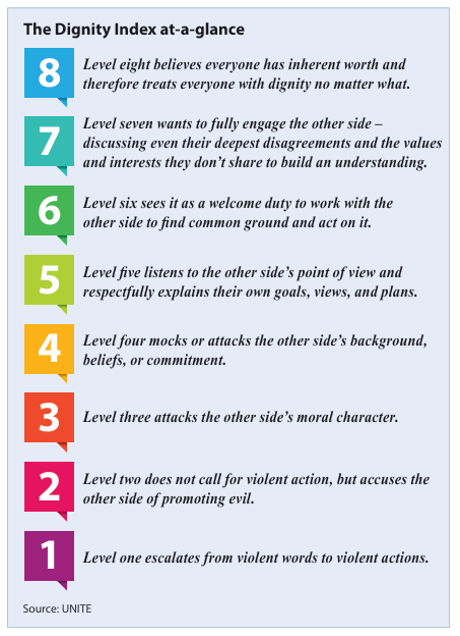
Source: Bar-Tal, 2000; Haslam, 2006; Nussbaum, 2016 Following Beaver and Stanley’s (2023) definition of language as a contextual endeavor where the same word can produce different meanings in different recipients based on their background, political attitudes, or values, all three quotes will be first analyzed through the context in which they were spoken. Consequently, it will be assessed how and why these quotes meet the criteria of dehumanizing speech—who is being targeted, on what grounds, what is the nature of the in-group/out-group divide, what terms are used to refer to the outgroup, what resonances (Beaver & Stanley, 2023) might the language evoke in its recipients. Finally, to evaluate the potential impact of dehumanizing speech utilized by the representatives of the Slovak government on collective, and by implication individual, experience of dignity, this study will scrutinize the selected quotes according to The Dignity Index developed by the UNITE initiative (UNITE, 2022). The Index works with an eight-point scale, denoting various forms of dignity-assaulting language (see Figure 2) with speeches that score in the lower half of the scale representing different forms and intensities of verbal dehumanization, and speeches that score in the upper half of the scale representing various levels of a dignity-respecting approach based on Donna Hicks’ (2011) essential elements of dignity (UNITE, 2022).
Figure 2: The Dignity Index
Source: Bell, Byrne, Meppen & Graham, 2023 Limitations A few limitations of this study, given its focus and research design, must be addressed before continuing further. Since the main objective of this study is to investigate the potential harmful influence of political discourse on collective experience of dignity, this study will only look at speech acts delivered by political elites. Consequently, the last part of the hypothesis, namely that dehumanizing language can also elevate the dignity of its users, will be only implicitly verified. However, since academic literature does show that dehumanization and dignity interact with each other in both a negative and a positive way, it should be logical that, if the negative aspect is proven on the side of the addressees, the positive aspect should be inferred on the side of the addressants.. Although special attention should be also paid to the possible use of dehumanizing language on the side of the Slovak opposition, unlike parliamentary opposition, government representatives hold power and responsibility, have direct influence over citizens’ lives, and are usually given more space in the media sphere. Therefore, this study will only focus on the occurrences of dehumanizing language on the side of the incumbent cabinet.
Analysis Example One: Leeches On October 28, 2024, Slovak Minister of Culture Martina Šimkovičová (SNS party) faced a vote of no confidence in the National Council of Slovak Republic initiated by the opposition MPs on the grounds of Mrs. Šimkovičová’s alleged unfitness for the post, incompetency in managing the ministry, and hostility to minorities all across the board (Návrh 2024/387, 2024). The vote of no confidence followed after several highly criticized and controversial steps and policies were put into place by Mrs. Šimkovičová since her ascension to office. She had shut down all state funding of projects related to the LGBTQI+ community (Močková, 2024), she had fired several managers of state art institutions (Jabůrková, 2024; Katuška, 2024), she had dismantled the Slovak public service provider RTVS and replaced it with a new, highly politicized television and radio station (Lodová & Biró, 2024), she had paralyzed Slovak Arts Council (Rehák & Janešíková, 2024), a state fund responsible for distributing financial support to culture related projects, she had tried to silence her critics with lawsuits (Aktuality.sk, 2024; TASR, 2024), and she had verbally assaulted a renowned Slovak artist and an outspoken member of the LGBTQI+ community for his publicly displayed painting of two nude men kissing (The Slovak Spectator, 2023). Mrs. Šimkovičová’s policies were met with significant backlash from the members of the Slovak art scene and sparked a chain of public protests which culminated in a strike of cultural institutions led by a collective of prominent Slovak artists (Rehák, 2024). In her defense, Mrs. Šimkovičová tried to refute the calls for her resignation with a conspiracy theory about NGOs and liberal opposition MPs embezzling state funds, and dismissed all arguments of the opposition as a plot to prevent her from dismantling their scheme (Národná rada Slovenskej republiky, 2024b). In that speech, Mrs. Šimkovičová stated the following: “Ladies and gentlemen, nothing is in decay. It is just that some of your friends in state institutions have lost their posts, and quite rightly so, because they have demonstrably failed to manage the organisations entrusted to them by former Ministers of Culture. At the same time, other friends of yours in political NGOs are afraid that their source of state support from various funds, on which they have been literally sucked like leeches for years, will gradually dry up. And so you call protests in the squares, you organise strike emergencies.” (Národná rada Slovenskej republiky, 2024b, 01:29:36–01:30:16) As demonstrated by this short excerpt, the speech of Mrs. Šimkovičová displays explicit signs of dehumanizing language and erodes the dignity of its addressees. All throughout the speech, Mrs. Šimkovičová clearly singled out an out-group allegedly consisting of the elites, opposition MPs, the journalists, NGOs, civil activists, LGBTQI+ people, and members of the art community who disagree with her policies. As their common identifier, Mrs. Šimkovičová picked their supposed devotion to liberal ideology. By associating these groups with leeches, Mrs. Šimkovičová debased them to the level of parasitic organisms, removal of which would seemingly benefit the state. She also accused the out-group of posing a threat to the national identity of Slovak citizens, and to advance its contagious image, she needlessly pointed out an HIV diagnosis of a former opposition MP. Furthermore, Mrs. Šimkovičová attempted to deny the agency of her critics by claiming that their activities are funded by George Soros, and by associating non-political actors, such as NGOs, journalists, or artists, with a political ideology, making their resistance seem more like a struggle for power than genuine exercise of their civil rights. All in all, her speech was riddled with verbal dehumanization and attacks on the dignity of her opponents. Crucially, while humiliating the out-group, Mrs. Šimkovičová also articulated a sense of denied superiority of the in-group which she claimed to represent. When trying to refute the accusations of her hostility towards minorities, Mrs. Šimkovičová turned dignity into an object of conflict, stressing that while she agrees that the dignity of all people should be respected, it should not happen at the expense of other people. Therefore, she implied that somehow, recognizing the dignity of minorities erodes the dignity of the majority. Moreover, Mr. Šimkovičová prodded at the idea that the out-group usurped the sole right to dignity. For instance, at the outset of her speech, Mrs. Šimkovičová asserted that liberal politics seeks to humiliate and mock its opponents, and continued to blame the parliamentary opposition for not paying any mind to ordinary citizens. Furthermore, Mrs. Šimkovičová claimed to speak for a silent minority of artists who have allegedly been systematically oppressed by a “liberal-progressive… mafia in Slovak culture” (Národná rada Slovenskej republiky, 2024b, 01:35:09–01:35:15), and argued that her effort is to end the era of “chosen-ones” (Národná rada Slovenskej republiky, 2024b, 01:40:11–01:40:15) in Slovak cultural industry. And to justify that effort, Mrs. Šimkovičová presented her policies as grounded in morals stemming from Slovak history, calling on sacrosanct traditions allegedly incompatible with the world-view of the out-group. By catering to grievances, depicting the out-group as an oppressor, indicating that the out-group is undeserving of financial resources, claiming the right to morality, and suggesting that dignity is a zero-sum game, Mrs. Šimkovičová implied in her speech that people unfavorable of the out-group, which is allegedly bound together by liberal partisanship, are already losing the fight for dignity, and that only through diminishing the out-group can they have their own dignity restored. Example Two: Progressive-liberal Cancer On May 15, 2024, during an official visit to a small town in central Slovakia, Handlová, Slovak Prime Minister Robert Fico (SMER-SSD party) survived an assassination attempt by a lone wolf who disagreed with the policies of Mr. Fico’s cabinet (Benedikovičová, Vražda, Folentová, Mikušovič, 2024). After the incident, Mr. Fico retracted from the public spotlight for several months, reappearing for the first time in early July of the same year to deliver a speech at national celebrations of St. Cyril and Methodius Day. In his public address, Mr. Fico arbitrarily connected the shooter from Handlová with Slovak opposition, urged for a joint effort to stand against liberal politics, and accused liberal politicians of fuelling hatred and radicalizing Slovak citizens (STVR, 2024). In front of a crowd consisting of former presidents, prominent state representatives, diplomats, religious authorities, and numerous citizens watching the speech on television, Mr. Fico pronounced the following: "I want to make a large appeal. We must all together build a huge dam against the nonsensical progressive and liberal ideologies that are spreading like cancer. They are ideologies that are damaging this country. They are ideologies that were created perhaps only the day before yesterday." (STVR, 2024, 01:01:48–01:02:08) The quote of Mr. Fico represents a specific kind of harmful language called hustle. Beaver & Stanley (2023) define hustle as a form of non-transparent speech used to convey inappropriate or hateful messages to a group of people who can decode meanings imbued into that message because they share a common understanding of reality, attitudes, opinions, or values, while at the same time giving the speaker plausible deniability over what has been said. Mr. Fico does not explicitly attack a selected out-group, instead he targets “liberal and progressive ideologies” (STVR, 2024, 01:01:48–01:02:08). However, it is obvious that behind these so-called ideologies stand physical people who subscribe to them. In parliamentary elections of 2023, the only two Slovak liberal parties, Progressive Slovakia and SaS party, gained well over 720-thousand votes combined, finishing at the second and the sixth place with 17.96% and 6.32% share of total votes, respectively (Štatistický úrad Slovenskej republiky, n.d.). As of February 2025, these two parties only gained public support, polling shows, with Progressive Slovakia now polling between 22% and 24%, and SaS between 6.2% and 7.1% (SME, n.d.). Moreover, at a later point of his speech and in a much more explicit manner, Mr. Fico accused Slovak media of spreading “liberal and progressive ideologies” (STVR, 2024, 01:01:48–01:02:08). And he also implicitly marked Slovak opposition parties, half of which are liberal, of inciting hatred in Slovak society. Thus, when understood as hustle, Mr. Fico’s term “progressive and liberal ideologies” (STVR, 2024, 01:01:48–01:02:08) tacitly targets specific groups of people—liberal political elites, voters subscribing to liberalism, and journalists critical of Mr. Fico’s government. Understood as hustle, Mr. Fico’s speech is evidently dehumanizing, and encroaches on the dignity of specific groups of people. He portrayed the out-group, allegedly bound by liberal identity, as a threat to the Slovak nation. With a call to “build a dam” (STVR, 2024, 01:01:48–01:02:08), Mr. Fico created a sense of stress and a need for defense from an external threat. By labeling liberalism and progressivism as “cancer” (STVR, 2024, 01:01:48–01:02:08) and suggesting they damage the country, he also implied that the threat can be deadly. Furthermore, in his address, Mr. Fico associated “normality” (STVR, 2024, 01:01:35–01:01:48) with Christianity, Slavic ethnic heritage, and the legacy of St. Cyril and Methodius, two Byzantine missionaries and envoys to emperor Michal the Third who were dispatched into the region of Great Moravia to educate Slavic people, spread Christian faith, and translate key religious texts into old church slavonic. Mr. Fico then went on to suggest that “progressive and liberal ideologies” (STVR, 2024, 01:01:48–01:02:08) are incompatible with this supposed “normality” (STVR, 2024, 01:01:35–01:01:48) and stand in stark contrast to an alleged identity of the Slovak nation, which Mr. Fico described as good, helpful, peace-loving, and open. Finally, as a form of protection to liberalism and progressivism, Mr. Fico suggested the adoption of constitutional measures. To sum up, Mr. Fico’s July the 5th speech is dehumanizing because Mr. Fico identifies an out-group characterized by shared attitudes, labels the out-group with a dehumanizing term, makes a case for the out-group being a threat to the survival of the Slovak nation, and calls for extraordinary measures to be put in place in response to the alleged threat. Example Three: Possessed by the Devil On October 8, 2024, at a press conference dedicated to financial state support of municipalities, the representatives of the governing coalition were asked by a journalist to address ongoing tensions between the three parties of the coalition (TA3, 2024). As part of his vitriolic response to the question, Prime Minister Robert Fico accused the media of disrespecting election results and contributing to the attempt on Mr. Fico’s life in May of that year by fuelling hatred among Slovak citizens: “Do you even read what you write? Do you even read it after yourself? I don't know, but I don't think that you do. Because if I were a normal person working at the Daily N and I read what you guys produce in 24 hours, I would run away from there because that's, that’s hatred. You are obsessed. You are possessed by the Devil. Same goes for Daily SME and Aktuality.sk.” (TA3, 2024, 00:32:51–00:33:11) As in the previous example, this statement of Mr. Fico is also dehumanizing. A specific out-group was selected, the journalists of three major Slovak press houses, bound together by their occupation and shared identity of the press corps. Mr. Fico accused the out-group of threatening Slovak society by sowing hatred and questioning the cornerstone of Slovak democratic regime, the elections. By challenging the quality of their journalism at the beginning of the quote, Mr. Fico tried to undermine the credibility of the journalists, and by referring to them as “possessed by the Devil” (TA3, 2024, 00:32:51–00:33:11) he also encroached on their agency. Furthermore, hidden in the words “possessed by the Devil” (TA3, 2024, 00:32:51–00:33:11) lies an implication that the journalists are not acting out of their own will, but receive instructions from an external source with malicious intent, making them malicious as well by proxy. The statement of Mr. Fico is especially harmful if seen as part of an alarming trend in Slovak public discourse—demonization of journalists by state authorities. In 2024, Slovakia ranked 29th in RSF’s World Press Freedom Index (Reporters Without Borders, 2021). As the organization notes in its analysis of Slovak media landscape, Slovak “journalists work in a hostile environment” (Reporters Without Borders, 2021, para. 1) while the representatives of the governing coalition “attack critical media and refuse to answer their questions” (Reporters Without Borders, 2021, para. 3), inspiring the public to act towards journalists with the same hostility. During his four governments, Prime Minister Robert Fico has frequently labeled journalists with dehumanizing terms, such as “filthy anti-Slovak prostitutes” (Tódová, 2016, para. 4), “terrorists” (Kráľová, 2018, para. 1), “an organized criminal group” (Fico, 2022, 00:04:15–00:04:20), or “blood-thirsty bastards” (TA3, 2024, 00:33:54–00:34:06). On other occasions, Mr. Fico has connected Slovak journalists to George Soros (Fico, 2023; Fico, 2024). Moreover, an in-depth analysis of social media posts of Slovak politicians and political parties ahead of the 2023 parliamentary elections, from which Mr. Fico’s party emerged victorious, uncovered that out of all political parties, Mr. Fico’s SMER-SSD party targeted journalists with negative messaging the most and almost quadruple as much as the party which ranked second in the analysis (Farská, Sólymos, 2023). While not all of these posts were downright dehumanizing, the analysis does illustrate a trend of verbal assaults on Slovak journalists from places of political power. The Dignity Index Evaluation Conclusively, the speech of Slovak Minister of Culture Martina Šimkovičová delivered as her defense to a vote of no confidence displays clear symptoms of animalistic dehumanization, and on The Dignity Index scale, it ranks at the penultimate number two. Mrs. Šimkovičová used the negative stereotype of leeches to defame her opponents, allegedly bound by liberal affiliation. The comparison to leeches also created a sense of undeservingness of the out-group, especially salient in the context of Mrs. Šimkovičová’s accusations of money embezzlement. Moreover, the word ‘leeches’ evoked a sense of alienness and the impression of an external threat. Throughout the speech, Mrs. Šimkovičová enumerated stories supposedly illustrative of the out-group’s immorality and wrong-doings, which is an important feature of the second stage of The Dignity Index. Though references to sub-human categories are characteristic of the first stage of The Dignity Index, calls for elimination of the out-group are clearly lacking in Mrs. Šimkovičová’s speech, and their absence therefore disqualifies the speech from receiving the score of one. The second example, the speech delivered by Prime Minister Robert Fico in early July 2024, exhibits features of dehumanization by reference to maladies, and can be ascribed value of one on The Dignity Index scale. By labeling his liberal and progressive opponents as cancer, he created an out-group with seemingly inhuman and deadly properties. Furthermore, drawing on Slovak history, mythology, and ideas of nationhood later in his speech, he also explicitly excluded the out-group from the supposedly natural image of Slovak nation, banishing them outside of both human and political communities. Because his targets were bound by a common political affiliation, their implied alienness undermined the ideas of democratic pluralism and free engagement in political competition. Moreover, by indicating that the out-group is spreading and corroding the society, Mr. Fico created a sense of urgency worthy of a swift response to the supposed danger. With a straightforward call for everyone to stand up against the out-group, Mr. Fico also used his leverage as a Prime Minister to propose legal measures to ostracize and disempower the out-group. The comparison of the out-group to cancer, however, suggests more drastic solutions akin to the total removal of the out-group if the well-being of the state, which the out-group allegedly threatens, is to be preserved. Undoubtedly, the speech of Mr. Fico fulfills all criteria to be graded with the lowest score of The Dignity Index, number one. Finally, the third speech act, also delivered by Prime Minister Robert Fico, falls into the category of dehumanization by means of derogatory language, and ranks at number three of The Dignity Index scale. In that instance, Mr. Fico verbally assaulted the journalists of several respected Slovak press houses, spinning their reporting as possession by the Devil. The attack aimed to question the competency and expertise of the journalists in a patronizing and infantilizing manner, eroding their value as capable human beings in the process. Furthermore, Mr. Fico portrayed the journalists as enemies of the government, and implied that their work is motivated by malice. The seriousness of Mr. Fico’s statement is underlined by his past treatment of journalists, and the platform he used to diminish them—a press conference broadcasted to the general public in real time. Justifyingly, the third speech act is awarded with index three, as it utilizes personal attacks on the out-group, and suggests a conflict between the out-group and the state. Conclusion Dehumanization is most often studied as the practice of diminishing dignity of selected groups of people based on their ethnicity, gender, physical and mental well-being, or religious affiliation. This study set out to explore the erosion of dignity on the grounds of political partisanship by power-holders who are expected to represent their constituents. The analysis of three speech acts performed by the members of the fourth government of Slovak Prime Minister Robert Fico from November 2023 until November 2024 demonstrated the ways in which political elites choose to only represent a portion of their citizenry while humiliating their perceived adversaries. All three statements made by the representatives of Slovak government displayed characteristics of dehumanization and encroachment on the dignity of their addressees. Because the addressees were always groups of people, and because the attacks took place in a political context, collective dignity was being eroded. Consistently, Slovak representatives did not target ordinary people, but the elites who represent these people, such as politicians, or who serve them, for instance journalists, NGOs, or artists. In all three cases, members of the Slovak government imposed a common liberal identity on the out-group, and associated the out-group with dangerous, sometimes anti-state, or unlawful activities. The degree of dehumanization varied between the statements with each implying a different degree of alleged enmity between the in-group and the out-group, each using a different category of dehumanizing speech, and each proposing solutions of diverse character to deal with the threat supposedly posed by the out-group. Nevertheless, the analysis proved the weaponization of dehumanizing language by Slovak political elites in political competition. Crucially, this study also set out to investigate the potential for bolstering dignity through dehumanization, specifically on the side of the dehumanizers. Literature reviewed in the first chapter laid out solid foundations for the cynical assumption that a positive movement to dignity can be achieved by means of dehumanization. Several authors argued for the plausibility of dignity being experienced at the level of collectives, where it is closely tied to individual and group identity, its recognition, and its politicization (Tajfel & Leach, 1979; Mosquera, Vliek & Hirt, 2010; Pérez, 2013; Fukuyama, 2018). Additionally, research in social psychology proves that when devalued, groups of people can respond with activities aimed at restoring their group’s value, and that people tend to view their in-group more positively than the out-group (Tajfel & Leach, 1979; Mosquera, Vliek & Hirt, 2010; Pérez, 2013). Martha Nussbaum’s (2016) concept of status-focused anger which can seemingly be ameliorated by humiliating the perpetrator in return suggested that humans can engage in retributive action to restore their dignity. Dehumanization is a practice known for heavily encroaching on human dignity, and scholars agree that it can be disseminated and normalized among the masses through sustained exposure to dehumanizing techniques by individuals who dominate channels of communication and enjoy both virtual and practical authority (van Dijk, 1995; 2008; Bar-Tal, 2000; Haslam, 2006; Beaver & Stanley, 2023). In the analysis, at least two of the three statements can be considered as having the potential to raise the dignity of the in-group through humiliating the out-group—namely the first and the second statement. Both cases used divisive language, both characterized the out-group as immoral, criminal, dangerous, or patronizing, and both portrayed the in-group as honest, virtuous, or oppressed. An added sense of superiority and self-righteousness can be sensed in calls for action against the out-group, in both cases spoken by elites with authority bestowed upon them through the title of their office. The findings presented here spell important implications for the future of democracies as political parties rising to power across the Western world do not shy away from using dehumanizing language to generate voter support. According to Fukuyama (2018), legal protection of equal dignity is at the very foundation of liberal democracy. Similarly, Fuller (2003) concludes that the prime goal of democracy is to constrain power by making “rank-holders periodically accountable to those under their control” (Fuller, 2003, p. 93) as abuse of power “is incompatible with the principle of inviolate human dignity” (Fuller, 2003, p. 103). Moreover, Martha Nussbaum (2016) identifies the regulation of anger, including the status-focused type which seeks to diminish alleged perpetrators, with responsibilities of the state and justice system, so as to prevent humiliation from becoming a normalized form of punishment. Following Fuller’s (2003), Fukuyama’s (2018), and Nussbaum’s (2016) arguments, one can conclude that dignity is at the core of liberal democratic politics. The puzzle at hand is, therefore, how can a democratic regime be truly democratic if those who were elected to preserve its core values and to provide conditions for the well-being of everyone are dismissing entire groups of people as unworthy and unequal in the most fundamental feature of every human being—humanness. Fair political competition, which is at the very heart of liberal democracy, cannot exist if it becomes permissible to sacrifice one group of people for another. Healthy civil relationships cannot be maintained, and social cohesion cannot hold, if people are inspired by their representatives to see each other as alien, dangerous, or downright inhuman. And finally, the spectacle of loaded, harmful, divisive language, even if it borrows some dignity to those who feel unrecognized, cannot sustainably and genuinely fix the real problems which reproduce inequalities and cause dignity deprivation among vast numbers of people.
List of References
Abdeslam, A. (2021). Muslims and immigrants in the populist discourse of the French Party Rassemblement National and its leader on Twitter. Journal of Muslim Minority Affairs, 44(1), 46–61. https://doi.org/10.1080/13602004.2021.1903159
Aktuality.sk. (2024, September 25). Ministerka kultúry Šimkovičová podala trestné oznámenie na spisovateľa Hvoreckého [Minister of Culture Šimkovičová sues writer Hvorecký]. Aktuality.sk. https://www.aktuality.sk/clanok/vzVnIVk/ministerka-kultury-simkovicova-podala-trestne-oznamenie-na-spisovatela-hvoreckeho/
Bar-Tal, D. (2000). Shared beliefs in a society: Social psychological analysis. Sage Publications, Inc.
Baron-Cohen, S. (2012). The science of evil: On empathy and the origins of cruelty. Basic Books.
Beaver, D., & Stanley J. (2023). The language of politics. Princeton University Press.
Bell, S., Byrne, K., Meppen, D., & Graham, J. (2023) The dignity index: Utah pilot project technical summary. Kem C. Gardner Policy Institute. https://d36oiwf74r1rap.cloudfront.net/wp-content/uploads/DignityIndex-Jan2023.pdf?x71849
Benedikovičová, M., Vražda, D., Folentová, V., Mikušovič, D. (2024, May 15). Premiéra Fica v Handlovej postrelili, úrad vlády hovorí, že je v ohrození života [Prime Minister Fico shot in Handlová, his life is at risk, government claims]. Denník N. https://dennikn.sk/3992418/premiera-fica-v-handlovej-postrelili-previezli-ho-do-nemocnice/
Cassese, E. C. (2021). Partisan dehumanization in American politics. Political Behavior, 43, 29–50. https://doi.org/10.1007/s11109-019-09545-w
Doerr, N. (2021). The visual politics of the Alternative for Germany (AfD): Anti-Islam, ethno-nationalism, and gendered images. Social Sciences, 10(1). https://doi.org/10.3390/socsci10010020
Esses, V. M., Veenvliet, S., Hodson, G., & Mihic, L. (2008). Justice, morality, and the dehumanization of refugees. Social Justice Research, 21, 4–25. https://doi.org/10.1007/s11211-007-0058-4
Farská, K., Sólymos, K. K. (2023, October 5). Analýza: Pred voľbami na novinárov a médiá najviac útočil Robert Fico a strana Smer, platili si aj reklamu [Analysis: Ahead of the elections, Robert Fico and Smer party attacked journalists and media the most, even paid for advertisement]. Investigatívne Centrum Jána Kuciaka. https://www.icjk.sk/275/Analyza-Pred-volbami-na-novinarov-a-media-najviac-utocil-Robert-Fico-a-strana-Smer-platili-si-aj-reklamu
Fico, R. (2022, January 24). Organizovaná zločinecká skupina novinárov útočí na štátne inštitúcie! [An organized criminal group of journalists is attacking state institutions!] [Video]. Facebook. https://fb.watch/x-18CxKfMV/
Fico, R. (2023, June 20). Ste sa v tej Pravde už úplne pomiatli? [Have you gone completely insane in daily Pravda?] [Status]. Facebook. https://www.facebook.com/robertficosk/posts/ste-sa-v-tej-pravde-u%C5%BE-%C3%BAplne-pomiatlito-%C5%BEe-z-denn%C3%ADka-pravda-zostal-iba-%C4%BEavicov%C3%BD-/836517564499212/
Fico, R. (2024, June 5). Odpúšťam a varujem [I forgive and warn] [Video]. Facebook. https://fb.watch/x-2aGp-Npu/
Flores, R. D. (2018). Can elites shape public attitudes toward immigrants?: Evidence from the 2016 US Presidential election. Social Forces 69(4), 1–42. https://doi.org/10.1093/sf/soy001
Fukuyama, F. (2018). Identity: The demand for dignity and the politics of resentment. Farrar, Straus and Giroux.
Fuller, R. W. (2003). Somebodies and nobodies: Overcoming the abuse of rank. New Society Publishers.
Fuller, R. W. (2006). All rise: Somebodies, nobodies and the politics of dignity. Berrett-Koehler Publishers.
Gehrerová, R. (2025, February 19). Šimkovičová kritizuje zamestnávanie ľudí navštevujúcich psychiatra. Problémom sú skôr tí, čo sa liečbe vyhýbajú, tvrdia odborníci [Šimkovičová criticizing employment of psychiatry patients. The issue is with those avoiding treatment, experts claim]. Denník N. https://dennikn.sk/4475080/simkovicova-kritizuje-zamestnavanie-ludi-navstevujucich-psychiatra-problemom-su-skor-ti-co-sa-liecbe-vyhybaju-tvrdia-odbornici/
Gera, M. (2023). “Here, the Hungarian people will decide how to raise our children”: Populist rhetoric and social categorization in Viktor Orban´ ’s anti-LGBTQ campaign in Hungary. New Perspectives 31(2), 104–122. https://doi.org/10.1177/2336825X2311643
Goren, P., Federico, C. M., & Kittilson, M. C. (2009). Source cues, partisan identities, and political value expression. American Journal of Political Science 53(4), 805–820. https://doi.org/10.1111/j.1540-5907.2009.00402.x
Grabarczyk, J. (n.d.). Creating Enemies Before Elections. In M. Hodun (Ed.), Us/Them Hate speech at the service of politics (pp. 186–193). European Liberal Forum.
Hartling, L. (2007). Humiliation: Real pain, a pathway to violence. RBSE, 276–290.
Haslam, N. (2006). Dehumanization: An integrative review. Personality and Social Psychology Review, 10(3), 252–264. https://10.1207/s15327957pspr1003_4
Haslam, N., & Loughnan, S. (2014). Dehumanization and infrahumanization. The Annual Review of Psychology, 65, 399–423. https://doi.org/10.1146/annurev-psych-010213-115045
Haslam, N. (2022). Dehumanization and the lack of social connection. Current Opinion in Psychology, 43, 312–316. https://10.1016/j.copsyc.2021.08.013
Haque, O. S., & Waytz, A. (2012). Dehumanization in medicine: Causes, solutions, and functions. Perspectives on Psychological Science, 7(2), 176–186. https://doi.org/10.1177/1745691611429706
Helbling, M., Reeskens, T., & Wright, M. (2016). The mobilisation of identities: a study on the relationship between elite rhetoric and public opinion on national identity in developed democracies. Nations and Nationalism 22(4), 744–766. https://doi.org/10.1111/nana.12235
Hicks, D. (2011). Dignity: The essential role It plays in resolving conflict. Yale University Press.
Hodun, M. (Ed.). (n.d.). Us/Them: Hate speech at the service of politics. European Liberal Forum.
Jabůrková, N. (2024, August 7). Po Drličkovi prišla o šéfku aj SNG. Ministerka Šimkovičová odvolala Alexandru Kusú [After Drlička, Slovak National Gallery loses its manager, too. Minister of Culture Šimkovičová withdrew Alexandra Kusá]. Aktuality.sk. https://www.aktuality.sk/clanok/i9YKNoV/po-drlickovi-prisla-o-sefku-aj-sng-ministerka-simkovicova-odvolala-alexandru-kusu/
Katuška, M. (2024, August 6). Šimkovičová odstavila šéfa SND Mateja Drličku. Sporov s ministerstvom kultúry mali čoraz viac [Šimkovičová sacked the manager of Slovak National Theater Matej Drlička. Their conflicts with the Ministry of Culture only grew]. SME. https://domov.sme.sk/c/23366862/matej-drlicka-snd-simkovicova-odvolanie.html
Kráľová, Ľ. (2018, December 13). Fico: Novinári z Denníka N aj jeho majitelia sú mediálni teroristi [Fico: Daily N journalists and its owners are media terrorists]. Týždeň. https://www.tyzden.sk/politika/52206/novinari-z-dennika-n-su-obycajni-medialni-teroritsti-povedal-fico/
Lodová, F., Biró, M. (2024, June 20). RTVS si už od júla nezapnete. Martina Šimkovičová si presadila novú STVR [Since July, RTVS will no longer be available. Šimkovičová pushed the new STVR]. Aktuality.sk. https://www.aktuality.sk/clanok/bnmt6s3/rtvs-si-uz-od-jula-nezapnete-martina-simkovicova-si-presadila-novu-stvr/
Loughnan, S., Haslam, N., Sutton, R. M., & Spencer, B. (2014). Dehumanization and social class: Animality in the stereotypes of “White Trash,” “Chavs,” and “Bogans”. Social Psychology, 45(1), 54–61. https://doi.org/10.1027/1864-9335/a000159
Mikušovič, D. (2024, September 25). Nálepky Plavákovej z PS vyvolali ďalší koaličný spor, Huliak poslankyňu vulgárne urážal. Po Dankovi ju vykázal aj Gašpar (+video) [Stickers of MP Plaváková from PS sparked another coalition clash, MP Huliak scolded her with slurs. After Deputy Speaker Danko, Deputy Speaker Gašpar expelled her, too (+video)]. Denník N. https://dennikn.sk/4214431/nalepky-lucie-plavakovej-z-ps-vyvolali-dalsi-koalicny-spor-huliak-z-sns-poslankynu-nechutne-urazal/
Močková, J. (2024, November 6). LGBTI+ projekty nedostali z dotácií u ministerky Šimkovičovej „ani cent“. Je to absurdné, reagujú kvír organizácie [LGBTQI+ projects given “not even a cent” from Minister Šimkovičová. It is absurd, queer organizations react]. Denník N. https://dennikn.sk/4290521/lgbti-projekty-nedostali-z-dotacii-u-ministerky-simkovicovej-ani-cent-je-to-absurdne-reaguju-kvir-organizacie/
Leach, C. W., Mosquera, P. M. R., Vliek, M. L. W., & Hirt, E. (2010). Group devaluation and group identification. Journal of Social Issues 66(3), 535–522. https://doi.org/10.1111/j.1540-4560.2010.01661.x
Národná rada Slovenskej republiky. (2024a). 12. Schôdza [Video]. MediaPORTÁL Národná rada Slovenskej republiky. https://tv.nrsr.sk/archiv/schodza/9/12?MeetingDate=10052024&DisplayChairman=false
Národná rada Slovenskej republiky. (2024b). 22. Schôdza [Video]. MediaPORTÁL Národná rada Slovenskej republiky. https://tv.nrsr.sk/archiv/schodza/9/22?id=331420
Návrh 2024/387 (2024, Aug 16). Návrh skupiny poslancov na vyslovenie nedôvery členke vlády Slovenskej republiky Martine Šimkovičovej, poverenej riadením Ministerstva kultúry Slovenskej republiky [Proposal of a group of members of parliament for the vote of no confidence for the member of the government Martina Šimkovičová, Minister of Culture of the Slovak Republic]. IX volebné obdobie. https://www.nrsr.sk/web/Dynamic/DocumentPreview.aspx?DocID=550837
Nicolson, S. P. (2011). Dominating cues and the limits of elite influence. The Journal of Politics 73(4), 1165–1177. https://doi.org/10.1017/S002238161100082X
Nussbaum, M. (2016). Anger and forgiveness: Resentment, generosity, justice. Oxford University Press.
Pérez, E. O. (2013). Ricochet: How elite discourse politicizes racial and ethnic identities. Political Behavior 37, 155–158. https://doi.org/10.1007/s11109-013-9262-0
Petraňová, D. (2018). The more distant “Other”? Impact of the refugee crisis on the discourse about identity in the Slovak Republic. Kritika & Kontext, 53–54(12), 200–209.
Pietová, M. (2024, April 15). Opozícia pácha v zahraničí „ekonomickú vlastizradu“, Šimečka podľa Fica otočil a Ódorova vláda sa správala ako lenivé vši (video) [The opposition is committing an “economical suicide” abroad, MP Šimečka turned around and Ódor’s government acted like lazy lice, Fico claims]. SITA. https://sita.sk/opozicia-pacha-v-zahranici-ekonomicku-vlastizradu-podla-fica-simecka-otocil-a-odorova-vlada-sa-spravala-ako-lenive-vsi-video/
Pravda. (2021, November 2). Fico: Na Slovensku pôsobí Sorošova črieda prasiat [Fico: A Soros’ herd of swines operates in Slovakia]. Pravda. https://tv.pravda.sk/relacie/spravodajstvo/epizoda/7553-fico-na-slovensku-posobi-sorosova-criedaprasiat
Project Unite. (2022). The Dignity Index. https://www.dignity.us/index
Rehák, O., Janešíková, N. (2024, November 21). Nominanti Šimkovičovej sabotujú Fond na podporu umenia, nechodia na zasadnutia Rady FPU [Nominees of Minister Šimkovičová sabotaging Slovak Arts Council, skipping its meetings]. Denník N. https://dennikn.sk/4317760/nominanti-simkovicovej-sabotuju-fond-na-podporu-umenia-nechodia-na-zasadnutie-rady-fpu/
Rehák, O. (2024, September 19). Kultúrny štrajk už spojil mestá po celom Slovensku, protesty sa konali v štrnástich naraz [Cultural Strike connected cities all across Slovakia, protests took place in 14 towns at once]. Denník N. https://dennikn.sk/4205537/kulturny-strajk-uz-spojil-mesta-po-celom-slovensku-protesty-sa-konali-v-strnastich-naraz/
Reporters Without Borders. (2021). Slovakia. https://rsf.org/en/country/slovakia
Sata, R. (2023). Performing crisis to create your enemy: Europe vs. the EU in Hungarian populist discourse. Frontiers in Political Science, 5. https://doi.org/10.3389/fpos.2023.1032470
Schmitt, C. (1932/2007). The concept of the political. The University of Chicago Press.
SME. (n.d.) Preferencie politických strán 2025 [Preference polls 2025]. https://volby.sme.sk/pref/1/politicke-strany
STVR. (2024). Posolstvo Cyrila a Metoda [Video]. STVR. https://www.rtvs.sk/televizia/archiv/21213/474713#3712
Štatistický úrad Slovenskej republiky. (n.d.). Hlasy pre politické subjekty [Votes for political parties]. https://volby.statistics.sk/nrsr/nrsr2023/sk/vysledky_hlasovania_strany.html
TA3. (2024). TB koaličných strán a ministra investícií o dofinancovaní samospráv [Video]. TA3. https://www.ta3.com/relacia/961451/tb-koalicnych-stran-a-ministra-investicii-o-dofinancovani-samosprav
Tajfel, H. (1970). Experiments in intergroup discrimination. Scientific American, 223(5), 96–103.
Tajfel, H. (1982). Social psychology of intergroup relations. Annual Review of Psychology, 33, 1–39.
Tajfel, H., & Turner, J. C. (1979). An integrative theory of intergroup conflict. In W. G. Austin & S. Worchel (Eds.), The social psychology of intergroup relations (pp. 33–48). Brooks/Cole.
TASR. (2024, January 22). Rezort Martiny Šimkovičovej podal trestné oznámenie v súvislosti s petíciou na jej odvolanie [Ministry of Martina Šimkovičová filed a lawsuit related to a petition demanding her resignation]. Aktuality.sk.: https://www.aktuality.sk/clanok/0VgjKKR/rezort-martiny-simkovicovej-podal-trestne-oznamenie-v-suvislosti-s-peticiou-na-jej-odvolanie/
The Slovak Spectator. (2023, November 30). Culture minister outraged by a painting depicting queer love. The Slovak Spectator. https://spectator.sme.sk/politics-and-society/c/culture-minister-outraged-by-a-painting-depicting-queer-love
Tódová, M. (2016, November 23). Fico novinárom: Ste špinavé protislovenské prostitútky (+video) [Fico to journalists: You are filthy anti-Slovak prostitutes (+video)]. Denník N. https://dennikn.sk/614939/fico-novinarom-ste-spinave-protislovenske-prostitutky/
UNITE. (2022). The Index. https://www.dignity.us/index
Unlu, A., Truong, S., & Kotonen, T. (2024) Mapping the terrain of hate: identifying and analyzing online communities and political parties engaged in hate speech against Muslims and LGBTQ+ communities. International Journal of Data Science and Analytics. https://doi.org/10.1007/s41060-024-00571-4
van Dijk, T. A. (1995). Elite discourse and the reproduction of racism. In R.K. Whillock & D.Slayden(Eds.), Hate speech (pp.1-27). Sage Publications.
van Dijk, T. A. (2008). Elite discourse and institutional racism. In C. McCarthy & C. Taesley (Eds.), Transnational perspectives on culture, policy, and education: Redirecting cultural studies in neoliberal times (pp. 93–112). Peter Lang.
Ward, M. (2024). We watched 20 Trump rallies. His racist, anti-immigrant messaging is getting darker. Politico. https://www.politico.com/news/2024/10/12/trump-racist-rhetoric-immigrants-00183537