
Mafia State: Slovakia After the Velvet Revolution – misuse of power and privatization
After the Velvet Revolution in 1989, the newly elected president of Czechoslovakia, Václav Havel was giving amnesties to people who got imprisoned under the communist regime, but with that, many non-political criminals were given freedom as well. As publicist Tibor Szomolai writes in his novel The Clan (2020), some freshly freed people saw their future in the local privatizations, where they would be able to use the so-called “holland-method”, by letting the price drop the lowest possible, by not letting anyone else to licit, and then buying it, then, often resell it for higher price as it was originally presented at the audition. They could effectively prevent others from licit by showing up at the events accompanied by strong men, who would act threateningly towards the competition. If the competition was not stepping down, they would smash their cars or beat them up, for bistros, beauty salons, restaurants, and former “JRD”s. Thus, the purpose of privatization as such, as Kregar (2003) describes, shifted from denationalization and return of property to a semi-legal activity, an opportunity for organized crime groups to seek the goods and get advantage. In the higher level, where certain actors with the government were interested in owning a monopoly of an industry. As described by publicist Murín (2016), a mill was privatized by threatening the owner with a gun, that ‘either his signature will get on the paper or his brains’. These processes not only lead to wild capitalism, unfair competitions, people losing hope in the new system, but caused many well-established companies to wannish, factories with excellent potentials to go bankrupt because they ended up in the wrong hands, causing many people to lose their income thus becoming unemployed. My hypothesis is that because of Slovakia’s unique position after the Velvet Revolution and the newly regained independence, its political culture lacked enough intelligence and elites who would be able to guide it through the regime changes and then the privatization process, which was initially intended for denationalization and property return, took a dark turn, enabling organized crime groups to take advantage of it, meanwhile ruining former state property, and political figures for misusing their power.
**Historical routes for modernization **
To elaborate on that part of the hypothesis why Slovakia lacked intelligence and suitable elites, it should be explained through its historical background and position. In his work Social Origins of Dictatorship and Democracy, Barrington Moore (2020) argues that there are three major routes to the modern state: the bourgeois revolution, leading towards democracy, revolution from above by the ruling class, leading to fascism and peasant revolution, leading to a communist system. He describes key elements of each to happen, providing historical examples of chosen, bigger countries. He claims that violence is a key factor for each outcome, as for there were no peaceful revolutions. Another main aspect of his was the existing social classes, the position of aristocracy, the ruling class, and mainly the peasant question, to abolish peasantry thus new social classes could emerge, which he highlights as an important factor for modernization. For his analysis, Moore was studying six countries: England, France, the United States, Japan, India, and China, additionally mentioning Germany and Russia. Thus, to apply his theory to Slovakia is hard in the sense that it is a small country. Also, its position was different, as Bútora describes, due to firstly being part of the Austro-Hungarian Empire, which was a dual monarchy, then the First Czechoslovak state with democratic values, which existed till the Second World War, when Slovakia became an independent state for the first time, yet it was a fascist puppet state of Germany. After defeating the Nazi regime, Slovakia was part of the Second Czechoslovak state, which became a satellite state of the Soviet Union, therefore with a socialist regime type. It lasted till the 1989 Velvet Revolution, when democratization began, and then in 1993, Slovakia became a separate state, now as a sovereign, free, democratic state (1993). Moore’s analysis focuses on the social classes, namely the landed aristocracy and the peasants, their relationships, and the given country’s agriculture and industrialization (or lack thereof). At that time, when the social and industrial changes were happening in Europe, Slovakia was part of the Austro-Hungarian Empire, by the end of the World War I, when Czechoslovakia was born. As Beneš argues, when part of the Empire, Slovakia had no autonomy as other nations within, thus their rights were limited. It was a land with strong agricultural aptitude; therefore, peasants were the most numerous class. Slovak landed aristocracy was rare due to Magyarization and other factors such as limited legal use of the Slovak language, not permitted in education and holy masses, making it hard to establish Slovak intelligence as a bourgeoisie class (1967). After the First World War, Slovakia became a part of Czechoslovakia, till the Second World War. It was an alliance of two similar yet different nations, where Slovakia was largely rural and economically underdeveloped in contrast to the more urban and already industrialized Czechia (Bútora, 1993). The first Czechoslovak state was established right after the collapse of the Austro-Hungarian Empire, which was an opportunity to present a new political order. Also, democratic values were supported by the international context. Starting from Woodrow Wilson, the UK and France tended to be supportive towards the new democratic order (1993). In the Czech part of the country, there was a more urbanized population, the working class instead of peasants, who were supporting democratic values. The absence of the landed aristocracy was also helping the process (Stephens, 1989).
Another of Moore’s core points towards the modern state is when and how the country industrialized. As Baláž (2007) describes, industrialization in Slovakia, it mainly happened during the second Czechoslovak state, after the 1950s “district industrialization”, which meant that a particular enterprise was installed into a region to provide economic growth and employment. These were mostly heavy industries and factories, which did create enough workplaces for former peasants and rural workers.
The agricultural reform was as well connected to Soviet planning, by introducing collectivization. The most important aspect was the Unified Agricultural Cooperatives, where the farmers were asked to enter voluntarily, yet in reality it was mandatory. Lands and animals were collected there, so that no private ownership of land remained (Lieskovský et al., 2014). Since Slovakia was an agricultural state, working on land was still very important, just the structure was now different, by state ownership and socialist regime change. To align with Moore’s perspective about the importance of breaking the power of the traditional elites, this kind of land reform was also serving the purpose.
A different point of view on state’s modernization was presented by Tilly (1985), who mentioned that states are modernized or created due to war. He said that state making is an organized violence, and his main argument was “states make war and war makes states (p. 170). Tilly mentions four main activities to do so, namely war making, state making, protection and extraction.
War making in the case of Slovakia is its role in WWI, which resulted in the establishment of the Czechoslovak state. In WWII, and then in the Slovak National Uprising, it helped to strengthen the Slovak national identity. State-making results in centralization of power and the creation of representative institutions. In Slovakia, those mainly happened during the First Czechoslovakian state, where a democratic government was established with a legal framework, and state institutions, administration, and infrastructure for support. Protection, which means that the state is responsible for maintaining order and law, also must be able to protect its citizens and provide security for them. In the case of Slovakia, those things also happened during the first Czechoslovak Republic, which was able to create a secure and stable environment for its citizens in order to support economic growth. Extraction is, as Tilly argues, when the citizens are paying taxes in exchange of protection from the state and providing of public goods. Taxes are used for the state’s economic development and that a state would be able to operate itself. In Slovakia’s modernization context it also means taxation, which was the resource for financing education and infrastructure, which areas were important throughout all the phases (Beneš, 1967).
**Political Culture **
As Almond and Verba (1963) described, the term ‘political culture’ refers to the political orientations, attitudes towards the system and its parts. It is a set of orientations towards a set of social objects and processes.
As David Easton (1973) distinguished, there can be various support for the political system, namely specific and diffuse support. By specific support, he means, what the political authorities do and what outcomes they produce, meanwhile citizens are aware of that, and they can show their daily support, towards the system - in Slovakia, democracy. If there is a change, the citizens can show their subjective opinion, but it will not influence the process. The other kind is the diffuse support, which relates more to values and norms of the system itself. Citizens are aware that their voices matter alongside with the democratic values. The main principles of the diffuse support are trust and legitimacy, where, in case of trust, citizens can expect that authorities will act accordingly with their values, and by the legitimacy, he means the fact that the system is just and aligns with the morals and values. It is crucial for the state to secure citizens’ trust in the state to have a functioning civic society.
To understand why the privatization process could happen as it did, and why HZDS was the most popular party, it can be useful to measure specific support in Slovakia in the 90s. There are various subtopics to look at, just like policy and institutional support, alongside with support for the authorities. For the diffuse support, there are historical and cultural factors, national identity and support for democratic values and general system support. Beginning from the first democratic elections in Slovakia in 1992,, the HZDS was the most successful party, winning the elections with 37.26%, keeping their winning place again in the next election in 1994 with 34.96% (Haughton, 2001).
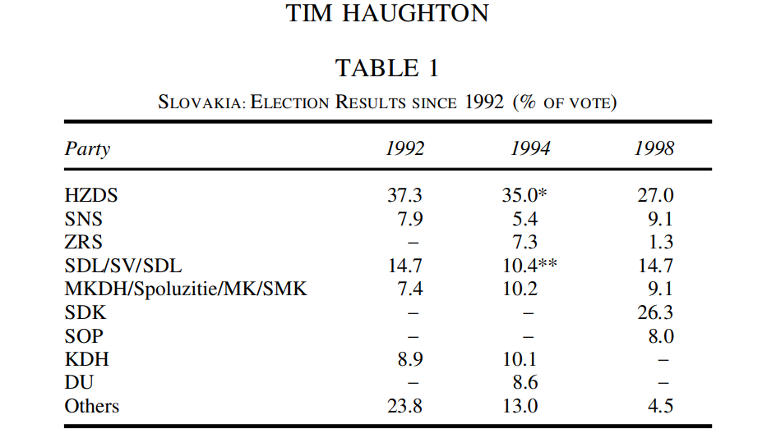
According to current survey polls, Mečiar’s party was the most popular one, mostly among the older generations. His populist messages were successfully delivered to the audience, by e.g. continuing some socialist traditions, like mass-celebration of women’s day, where he would gift flowers to the “babky demokratky” - a satirical nickname for the older women who supported him, often calling him “náš Vladko”. His and the party’s popularity surprisingly did not increase drastically as one would expect even after the 1995 kidnapping of the president’s son, Michal Kováč jr.. In the 1998 elections, HZDS still had the most votes, yet the opposition was able to form a coalition, thus out-numbering the HZDS (Krause, 2003).
Support can be influenced by the media as well. In the 90s, there was not many media opposition towards Meciar, only the newspaper SME was significantly criticizing them, as Mečiar often noted, they were being obsessed with him, he complained that everyone blamed him for everything: “because in Slovakia it's this way: the bus is late, the hens aren't laying eggs - it must be my fault” (Stoll, 1999).
Almond and Verba were defining civic culture as a political culture, which is a balance between the three main types: participatory, subject and parochial citizenship. Those can be naturally mixed, like it is in Slovakia as well.
They claim that for a stable and most conductive democracy, active citizen participation and engagement in politics is necessary, which are the main characteristics for the participative culture. Citizens overall can be active or passive. The active citizen is, who is involved in politics, follows it actively, is well informed, has a basic civic understanding and education, to be able to make a reasonable decision, e.g., when going to vote, can carefully weigh the alternatives. In contrast, the passive citizen, is a nonvoter, is poorly informed and apathetic towards democracy, indicates a weak democracy.
The civic culture by Almond and Verba consists of three main types: parochial, subject and participant.
Parochial culture is characterized by low levels of political engagement and awareness. Citizens having not much political knowledge and are not actively involved in politics, they have no interest, as politics is considered distant and irrelevant, having no effect on their daily lives. These cultures are often traditional, found in pre-modern societies, villages where people’s daily lives were about their daily work, family, kin and church, would not concern themselves with the happenings in the faraway capital. This culture can be found nowadays as well, one of its main aspects is that people would focus on religion, family or community matters. Mostly, they would care about their socio-economic matters.
This can be observed in Slovakia’s rural areas mainly, where citizens would, if they do, engage themselves maximally in their local politics of their towns or villages, but feel alienated from country politics, feel apathy and show no interest in that.
It is harder to make a liberal democracy where this particular political culture is the dominant one, the transition is quite hard, to change from the subject-like mentality, where listening to the authorities was the priority, to make the decisions themselves, is hard.
Subject culture is an intermediate type of political culture, where individuals do have a certain political knowledge and are politically more aware and engaged, but their involvement is limited, to obedience to authorities. Citizens see the importance of politics, but they rather not engage in political matters and decisions, tend to follow established roles and not question the decisions of the authority figures. These kinds of cultures are often found in semi-authoritarian and authoritarian regimes.
In Slovakia, there are certain segments of the population, who may exhibit subject political culture, where the political participation has limited impact or if political elites hold significant power.
Those two cultures can be the “inheritances” from the previous system in Slovakia, thus, that’s why the older generations are mainly part of those two types of cultures, meanwhile, the younger ones are more associated with the participant culture.
The participant cultures are characterized as the basis for strong democracies, with citizens having a high level of political engagement and awareness. They are well informed and both active, participating in the political process when they can, voting in the elections, joining organizations, going to protests, discussions, etc.; they play an active role in shaping the democracy.
In Slovakia, the urban areas and the younger generations, and certain professional groups may display participant political culture. This can be seen in high voter turnout, active civil society organizations, and widespread political discussions and activism.
Overall, Almond and Verba's work highlights the significance of civic culture in influencing the strength and stability of democratic systems and can be the key for the success of democracies in different nations. Political socialization, education, and communication in shaping civic culture. Efforts to promote civic education and democratic values are crucial for the long-term stability of democracy.
To conclude, a vibrant civic culture, characterized by informed and engaged citizens who hold democratic values and actively participate in political life, is essential for the well-functioning of democratic societies.
Political culture in Slovakia in the 1990s
The biggest change in the Slovak political culture occurred unquestionably after the Velvet Revolution, with the regime change. As Bútora (1991) describes, adapting to the new system did not mean only positive changes for the ordinary people, but some negative effects, like the lack of welfare and thus introduction of such terms like unemployment and homelessness. People living during the Socialism never had to experience those things, unemployment was non-existent, because everybody had to go to work, people would receive punishment if not doing so. But with the new capitalistic market rules, the employment rates were not sustainable as for there was more people employed for a given position than it was needed. Many people got fired from their positions, which, as publicist Szomolai (2020) writes, for first, did not seem horrible, because the unemployment benefits, but it was not a sustainable lifestyle for many, because the benefit money was “high” only for the first months, then it was lower. The people often lost their motivations and meaning of life after not being able to find a new job, often could not even believe such a thing can happen. Many of them gave up hope and become alcoholics, which was a great opportunity for organized crime groups, to reach out to those individuals and make “white horses” out them. That industry was born form the misuse of the state companies’ lagging payment policies, what which was based on the common trust between two (state owned) company back in the socialist regime, when one company was ordering the product and receiving it even before they paid for it – they could pay for it afterwards. With the regime change, companies were not changing their payment policies, what was often misused by the gangsters, by them ordering the products but never paying for it. But because police could go after them, they would find a company with a “white horse” as a CEO, who would sign all the papers, and after the trades, the company would go bankrupt. If the police want to go after somebody, there is the white horse.
Meanwhile, as Bútora claimed, Slovakia had to face economic hardships due to Czech decisions being not considerate enough. In the (Czechoslovak) country, the Czech were the more developed in industrial terms also. Slovakia’s industries were heavily dependent on importing raw materials, and it was mostly the result of the socialist planned-economy, regardless of the natural resources or the lack of that (1991).
The second biggest turn was the split of Czechoslovakia in 1993, initiated by the newly elected coalition of HZDS and the National party, the independent Slovak state being the latter’s goal, as well as their condition to make a coalition with the HZDS. Mečiar was not entirely sure at first, because the majority of the population was satisfied with Czechoslovakia, not wanting a sovereign state, thus he feared that it would harm his popularity (Hilde, 1999).
As Gould (2000) describes, the Slovak elites were not taking a united standpoint in this question. They were mainly split into two groups, one of those the „nationalist wing“, the supporters of the HZDS. Most of them were close to the party, often supporting their campaigns and thus gained financial benefits, promotions in positions afterwards, and getting the most of the privatization processes (Bútora, 1993).
The others were less united in terms of political standpoints, their common idea was anti-Mečiarism. They strongly opposed the wild privatization and fake nationalism what was put on display, often as a counterattack by Mečiar’s and his supporter’s sides, who claimed that anyone who is against them is because they are not „good Slovaks”.
Success of populist politicians
Norris and Inglehart (2019) are describing the rise of populist movements through the Cultural Backlash Theory, which states that the reason for the rise is a reaction for social and cultural changes that can pose a challenge for the traditional norms and values. It focuses mainly on the US and UK, which countries had a different development due to them not experiencing communism, but there are parallels and explanations valid for Slovakia.
It states that political shifts are not only caused by economic factors but also cultural ones. Rapid cultural changes, like new social norms, gender roles and multiculturalism could create discomfort for certain segments of the population, who perceive those as an attack on the traditional norms and values. The backlash is, thus, the desire to restore those. In Slovakia, after the Velvet Revolution, those new ideas could emerge, and considering that the population’s vast majority is also religious, would not easily welcome all the new ideas and norm the ‘West’ was offering. Thus, populist politicians, like Vladimir Mečiar, who knew they need to say to the people what they exactly want to hear, could pose as a character who is about to restore the desired ways of life, appealing desirable for the people living in their sweet nostalgia. To take it further, they would claim they share the same values as the group, so they want the same, to preserve the cultural identity, by fighting against the dangers, like globalization and the new-wave parties who would crash the values. Mečiar liked to put emphasis on the Slovak national identity, even at the expense of others, e.g. the minorities living in Slovakia.
From the beginning of his career in the VPN party, he was trying to appear as somebody who understands the things around him, and was confident. People were eager to choose a strong leader, who is compatible to bring stability. Him, or later on, his party HZDS was hard to categorize as a left-wing or right-wing, since, as Haughton (2001) describes, experts would claim, that the party “consistently acted to sustain the rule and political dominance of its leader, but otherwise its political program and ideological identity remained unclear”. They would mostly put it as Christian democrat/ conservative heading, which can be explained by Slovakia’s population mostly being religious, thus, Mečiar would not go against the church.
As every successful populist politician knows, they should embrace the fear of the people – in this case, the unknown, dangerous culture from the West, new ideas, norms, anti-religious views and globalization, which can be threatening for Slovak sovereignty. As Haughton (2001) argues, Mečiar would always stand up against it with a determination, to show he is ready to fight for the Slovaks, to protect them for any threats, coming from the inside or the outside, and that was something impressing for most of the people, to that extent, they would not mind his shady businesses, starting from having affairs with his „assistants“, to the 1995 kidnapping, misusing the slovak secret services for personal matters, and its close connections to famous figures, leaders of the underworld.
Conclusion
In conclusion, Slovakia’s path for sovereignty in the 1990s was affected by historical factors economic challenges, the regime shift and the rise of a populist leader. This leads to my hypotheses, that the privatization process, which was initially intended for denationalization and property return took a dark turn, enabling organized crime groups to take advantage of it, meanwhile ruining former state property, and political figures for misusing their power.
The historical roots, outlined by Barrington Moore can help to understand Slovakia’s position before the independence, its route to modernization meanwhile being part of the Austro-Hungarian Empire and later on, following up on Tilly’s perspective, emphasizing the role of World Wars, the establishment of Czechoslovakia and the first Slovak state, how it shaped Slovakia’s national identity.
The analysis of the political culture through Almond and Verba’s work reveals a diverse landscape in 90s Slovakia, with elements from parochial and subject cultures still remaining, along with the emerge of the participant culture mostly in urban areas, among the younger generation.
The political shift in Slovakia and Mečiar’s sudden popularity can be explained by Norris and Ingelhart’s Cultural Backlash Theory, that the socio-economic changes after the Velvet Revolution alongside with the economic uncertainties and lack of welfare created fear in people, for what populist leaders can easily address by the correct rhetorics. His leadership was paradoxical, as he used populist language for promising order and stability, yet he and his circle – his elite supporters, driven by financial interests in the privatization process – had questionable businesses and practices going on, which demonstrates the dynamics of politics in the 90s Slovakia.
References
Almond, G. A., & Verba, S. (2015). The civic culture: Political attitudes and democracy in five nations. Princeton university press.
Baláž, V. (2007). Regional polarization under transition: The case of Slovakia. European Planning Studies, 15(5), 587-602.
Barrington, M. (2020). The Democratic Route to Modern Society. In Classes and Elites in Democracy and Democratization (pp. 30-36). Routledge.
Beneš, V. L. (1967). The Slovaks in the Habsburg Empire: a struggle for existence. Austrian History Yearbook, 3(2), 335-364.
Bútora, M., & Bútorová, Z. (1993). Slovakia after the split. Journal of Democracy, 4(2), 71-83.
Butora, M., Butorova, Z., & Rosova, T. (1991). The hard birth of democracy in Slovakia: The eighteen months following the ‘tender’revolution. Journal of Communist Studies, 7(4), 435-459.
Easton, D. (1975). A re-assessment of the concept of political support. British journal of political science, 5(4), 435-457.
Gerring, J. (2004). What is a case study and what is it good for? American political science review, 98(2), 341-354.
Gould, J. A., & Szomolányi, S. (2000). Slovakia: Elite Disunity and Convergence. Elites After State Socialism. Lanham: Rowman & Littlefield, 47-69.
Haughton, T. (2001). HZDS: The ideology, organisation and support base of Slovakia's most successful party. Europe-Asia Studies, 53(5), 745-769.
Hilde, P. S. (1999). Slovak Nationalism and the Break-up of Czechoslovakia. Europe-Asia Studies, 51(4), 647-665.
Ježek, T. (1997). The Czechoslovak experience with privatization. Journal of International Affairs, 477-488.
Krause, K. D. (2003). Slovakia's second transition. J. Democracy, 14, 65.
Kregar, J. (2003). Organized crime as a threat to democracy. na.
Lieskovský, J., Kenderessy, P., Špulerová, J., Lieskovský, T., Koleda, P., Kienast, F., & Gimmi, U. (2014). Factors affecting the persistence of traditional agricultural landscapes in Slovakia during the collectivization of agriculture. Landscape ecology, 29, 867-877.
Lijphart, A. (1971). Comparative politics and the comparative method. American Political Science Review, 65(3), 682-693.
Murín, G. (2016). Mafiáni: Sýkorovci - Sýkorky. I.
Norris, P., & Inglehart, R. (2019) Cultural backlash: Trump, Brexit, and authoritarian populism. Cambridge University Press, pp. 32–64.
Stephens, J. D. (1989). Democratic transition and breakdown in Western Europe, 1870-1939: A test of the Moore thesis. American Journal of Sociology, 94(5), 1019-1077.
Szomolani, T. (2020). Klan: mafia a politika na Slovensku.
Stoll, D. J. (1999, December 5). Vladimír Mečiar: "The hens aren't laying eggs" spectator.sme.sk.
Tilly, C. (2017) War making and state making as organised crime. In: Author, Collective violence, contentious politics, and social change, Routledge, pp. 121-139.