
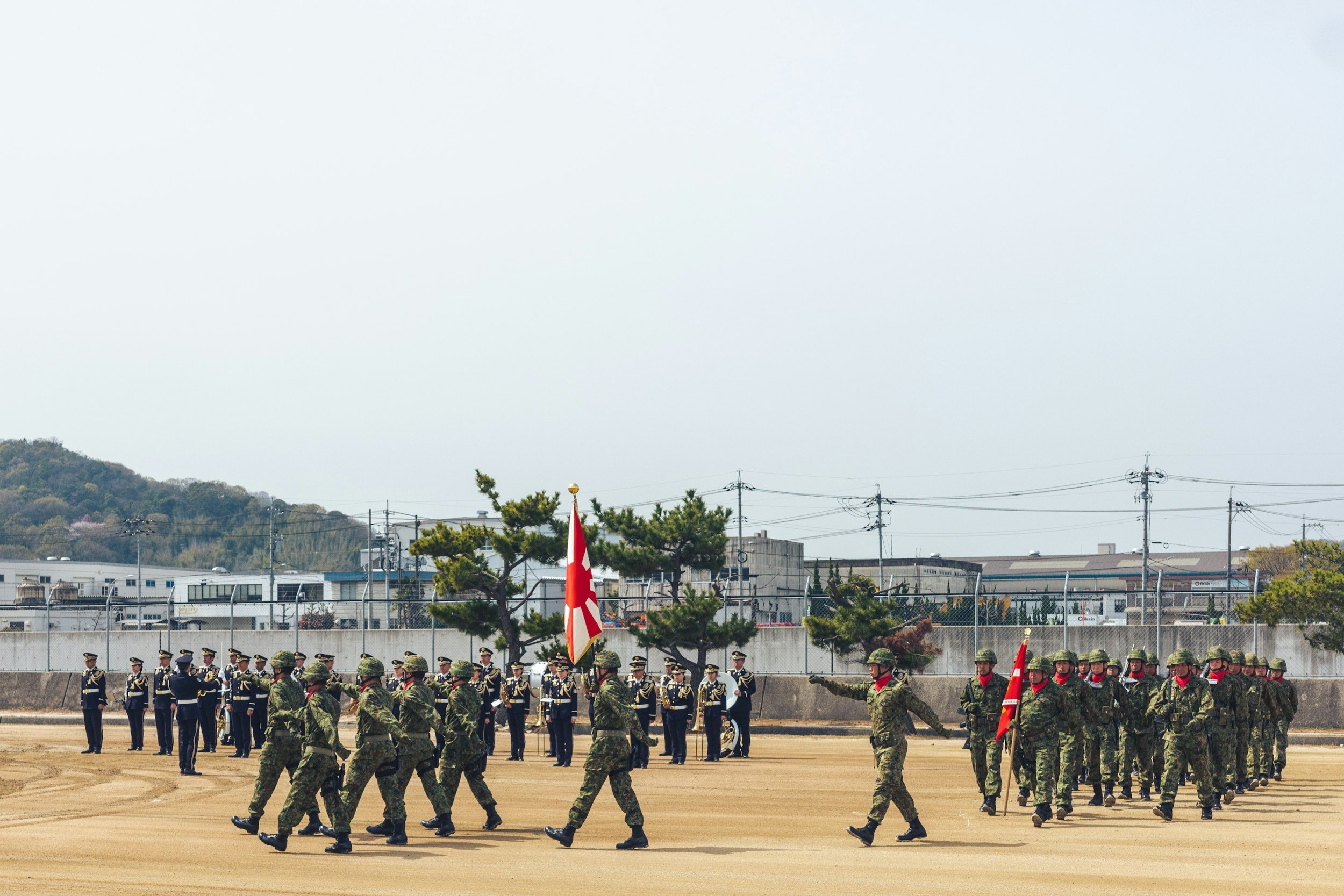
An Extinguished Sun: The case of Japanese militarization
Summary
Despite tensions with the countries that surround Japan, it is not really possible for thecnation to get up to the same standard as the other parties involved. This is due to Article 9 in the Japanese constitution, which is a remnant of the demilitarization initiative after the World Wars. This article is not necessarily a unique instance, as other countries have similar provisions in their legislation. However, the most important change that should take place is the allowing of the implementation of long-range missiles, as this would up Japan’s ability to defend itself in case of a heated conflict.
Historical background
The current wave of militarization is not the first time this has happened in the history of Japan. For a long time, Japan was an oppressive and fierce power in East Asia, always triumphing over its neighbors. This changed when the system of the shogunate was put into place. The principle of seclusion was established and made into law, which stated that Japan was forbidden from interacting with the outside world. In fact, anybody who tried to build ships and intended to leave the islands would be executed. This time period lasted roughly two centuries, from the 16 th to the end of the 18 th century, when the spread of colonial powers, mainly the Dutch and the English, reached the island of Japan and started diplomatic discussions about trade. Some agreements with these powers were reached which, during the period of the Meiji restoration, snowballed into the opening up of Japan. Aside from trade, another factor that influenced Japan were the shipbuilding practices and capabilities of the colonial powers. To gain and maintain influence in the region, the Japanese decided that they would need to build up their army. For a time, they had a sizable standing army, mainly to suppress revolts that were sweeping across the nation. However, the process of creating a navy was also started, largely inspired by British and French designs, and by the end of the 19 th century, Japan was once again close to the top of the hegemony over the seas. The timing of this buildup could not be more convenient, as Japan became involved in two major conflicts – the first Sino-Japanese war and the Russo-Japanese war. At the core of both of these conflicts was the Korean peninsula, which the Japanese, Chinese and, later, the Russians competed over. Japan won both of these wars, although it could not hold all of the peninsula (Dull, 2012). It is noteworthy to mention that, during the course of the war against Russia, the Japanese fleet effectively obliterated the Russian one, further cementing the importance of a strong navy in the minds of Japanese people and commanders. After the successful performance of the navy, military buildup resumed. However, the situation was complicated in the 1920s, after World War I, by the Washington Naval Treaty. The Treaty was created in order to prevent an arms race between the biggest players – the US, Italy, France, Japan and the British Empire – in the world scene, specifically by preventing the amount and, crucially, the types of ships these countries could build. Simply put, limiting just the number of ships that can be built is not enough, as capital ships, namely battleships, became bigger and more heavily armed. Therefore, each country had a maximum amount of tonnage for capital ships. The number of other warships was not limited, but their displacement could only be a maximum of 10,000 tons (Buckley, 1991). While the treaty did prevent some form of arms race, it inadvertently led to the nations experimenting and innovating within the constraints of the treaty. Battleships and battlecruisers became lighter and faster, while other classes of warships, like cruisers and destroyers, got more and more advanced. Crucially, with the advent of the plane, naval powers began experimenting with aircraft carriers, and Japan was the first to introduce an aircraft carrier built from scratch. A few other treaties followed afterwards, but they all effectively became null and void following the outbreak of World War II, especially once Japan showed just how formidable its navy really was in the Pacific Theater. It would eventually build the largest warships ever built, Yamato, which had a displacement of roughly 66,000 tons (Lyon, 1976). It may seem odd that only the Imperial Japanese Navy is being highlighted, but there is a reason for this. During the years of pre-war buildup, there was fierce competition between the different branches of the Japanese military. Each of them wanted to come out on top and get the most funding, and the IJN proved to me the most ruthless in this race. It lobbied, blackmailed and curried favor with the emperor, eventually surpassing the other parts of the military and becoming a strong political force of its own (Schencking, 2005). All of this then came crashing down after Japan surrendered to the United States, when the IJN was finally dissolved.
Other countries
After ending up at the losing side of the second world war, Japan was subdued and demilitarized by the US. At that time any idea of remilitarization and resurrection of the Japanese military was a nightmare for the region. Thus, the Allies occupied Japan until 1952. During that time, the Allies supervised the implementation and enforcement of the newly formed constitution. Article 9 states that in the name of their devotion towards international peace based on justice and order, they will renounce war as the tool of the state. They gave up their sovereign right to war, to threats and to the use of force as a means in disputes. Japan will do this through not maintaining land, sea and air forces together with other means of warfare. Nevertheless, Japanese renunciation is not a unique article in and of itself. Four countries have similar articles in their constitution: Germany, Italy, Costa Rica and South Korea. The two European countries, Italy and Germany, have similar articles in their constitutions. The Italian article rejects the instrumentalization of war as a choice for liberty and as a means for settling disputes. Further, similarly like Japan, Italy partially gives up its sovereignty. It goes a step further and encourages international organizations to promote similar ideas. On the other side, Germany makes any acts of disturbance of peace and preparation of war unconstitutional. One of the reasons why in Europe these articles are rarely mentioned is because both of the countries are part of NATO and the European Union. In other words, they are far from thinking about breaking their constitution or revising the articles. Another thing that connects them is the fact that they both were on the losing side of the WWII. The other two countries who have similar articles, but are not in the same proximity, are Costa Rica and South Korea. Costa Rica permanently abolished the Army as an institution. The only institution that is permitted are the police forces. However, they are also leaving a back door where sometimes a military force may be organized. Nevertheless, in such a situation it shall always be subordinate to the civilians. Costa Rica’s commitment to peace and aversion towards war is seen in their diplomacy and education. Through it, they are promoting peace and are pacifying the youth. South Korea, on the other hand, has compulsory military service. Nonetheless, through Article 5 of the South Korean constitution, Korea has renounced any way of aggression. Moreover, activation of the Armed Forces should come after national security is endangered, which is sacred, or for a defensive purpose of the land. The Japanese article in the constitution is not a precedent. There are many similar constitutions, even in countries with mandatory military service. Among those who are most similar to the Japanese constitution are Germany, Italy, Costa Rica and South Korea. The first two, Italy and Germany, do not have a purpose nor a potential threat from outside. Therefore, they are not revising, thinking nor even mentioning the article. They are both allies in NATO and part of the European Union. However, South Korea does not have many allies around their territory. Their article allows them to use the Armed Forces in some instance. However, in the constitution of Costa Rica, there are permanent abolishment of the army. Nevertheless, they still have left a hole where a military can get through. One of the most specific case is Costa Rica because they constitutionally subordinate to the civil power.
Legal considerations
Article 9 of the Japanese Constitution places restrictions and limits on the use and development of the Japanese military. The use of the constitution is directly visible in the naming of the military. While other nations call their militaries armed forces, Article 9 of the Japanese Constitution is partially the reason why the Japanese armed forces are called the Japanese Self Defense Forces (Port, 2005). The historical legacy of the rising sun, is a narrative that the nation still grapples with. However, the world of geopolitics and military politics has gravely changed since the 1950s. With advancements in defense, and the rise of the People’s Republic of China, and the nuclear program of North Korea, created new threats, and requires new solutions. In the age of modern warfare, it is argued that Article 9 of the Japanese constitution needs to be re- examined, and applied to the modern age of warfare and geopolitics. As a major non-NATO ally of the United States, Japan holds an important position geopolitically in East Asia. Looking back in time, the capitulation of the Japanese Empire, allowed the United States to mandate in what way the new Japanese nation would develop. While Article 9 represents a peaceful ethos in its implications, the many argue that in the current age of military tactics, particularly Article 9, Provision 2 which “prohibits the maintenance of armed forces or "other war potential", in its vague language, has effectively prevented Japan from being able to use long range guided missiles (Kurosaki, 2020). While long range guided missiles are particularly important in the tactics of an attacker, in the current weapons strategies, despite sounding like realist theory, long range missiles offer the ability to deter an opponent in an armed conflict (Kurosaki, 2020). Japan's self-imposed limitations on its military capability need to be reevaluated in light of its strategic context. The geopolitical balance in East Asia is becoming more and more unstable as regional tensions rise. A major obstacle is China's strong military posture, which is demonstrated by its territorial claims in the South China Sea and its swift naval buildup (Watanabe, 2018). Security worries are further compounded by North Korea's nuclear technological development and unpredictable behavior (Watanabe, 2018). Japan must review its defense strategy in light of these developments in order to protect its security and successfully promote stability in the area. It is controversial in Japan and among its overseas allies to revise Article 9 of the Japanese Constitution. Revisionists of the constitution contend that the existing limitations make it more difficult for Japan to respond to modern security risks (Weeks, 2023). They contend that a more accommodating reading of Article 9 would allow Japan to improve its capacity for deterrence, especially by acquiring cutting-edge defense weapons like long-range guided missiles. This modernization is considered essential to Japan's upholding of its duties as a major ally of the United States and to preserving a credible defense posture. Revision of Article 9 opponents believe that it will intensify regional arms races and threaten Japan's post-war pacifist identity (Weeks, 2023). They issue a warning that any effort towards remilitarization might incite hostile nations and cause instability in the area. Instead, they stress Japan's responsibility in advancing peace and stability through non-military means and call for stepping up diplomatic and economic initiatives to address security concerns. This viewpoint draws attention to the careful balance Japan needs to strike between strengthening its security capabilities and upholding its commitment to international peace. Ultimately, by considering both revisionist, and anti- revisionist stances, a middle group can be approached, by specifically addressing Provision 2, of Article 9. By amending, or rephrasing Provision 2, legally, Japan will be able to access weaponry that in the long term could bolster its defenses, while also deterring geopolitical opponents, all the while not interfering with the legacy of the demilitarization of Japan.
Works Cited
Buckley, T. H. (1991). The Washington Naval Treaties. In The Politics of Arms Control Treaty Ratification (pp. 65-124). New York: Palgrave Macmillan US.
Dull, P. (2012). A Battle History of the Imperial Japanese Navy: 1941-1945. Naval Institute Press.
Kurosaki, M. (2020, September 1). The dynamics of Japan’s “Armed attack initiation” doctrine and anticipatory Self-Defense. Default.https://www.lawfaremedia.org/article/dynamics- japans-armed-attack-initiation-doctrine-and-anticipatory-self-defense
Lyon, D. (1976). World War II warships. Excalibur Books.
Port, K. L. (2005). Article 9 of the Japanese Constitution and the Rule of Law. Social Science Research Network. Schencking, J. (2005). Making Waves: Politics, Propaganda, and the Emergence of the Imperial Japanese Navy, 1868-1922. Stanford University Press. https://papers.ssrn.com/sol3/Delivery.cfm/SSRN_ID686183_code332629.pdf?abstractid= 685118
Watanabe, A. (2018). Greater East Asia Geopolitics and its geopolitical imagination of a borderless world: A neglected tradition? Political Geography, 67, 23–31. https://doi.org/10.1016/j.polgeo.2018.09.005
Weeks, D. (2023, May 5). Japan’s Article 9: Pacifism and protests as defence budget doubles. Lowy Institute. https://www.lowyinstitute.org/the-interpreter/japan-s-article-9-pacifism- protests-defence-budget-doubles