Social Capital Through the Lens of Virtual Reality The impact of the WoW guilds on the individual’s social capital.
World of Warcraft (WoW) is one of the most well-known and well-loved MMORPG (multi-massive online role playing game) games with the peak of its popularity in 2010, when the global number of its subscribers reached 12 million players (Statista Research Department, 2016). In MMORPG, players level up their avatars and get to interact with other players in an open world. Hence, what distinguishes MMORPG from single-player video games is the co-presence as well as the social interactions in the game. It is a standard of MMORPG that nudges players to form various long-term in-game communities to enjoy a social atmosphere and achieve common goals that are not possible by a solo play. It is also usual for MMORPGs to have more challenging quests. This way, people are encouraged to create groups and cooperate to succeed in completing the task together (Taylor, 2006). Due to this community aspect, many social researchers examined the possible impacts and influences of MMORPG on social capital.
A group of five most acknowledged academics in the virtual communities research field carried out a first of a kind investigation of this topic in America. Their research, The Social Life of Guilds in World of Warcraft (Ducheneaut, Nickell, Williams, Xiong, & Yee, 2006), concludes that guild membership benefits players with both bridging and bonding social capital, and social skills. Similarly, Zhin-Jin Zhong, in her study regarding the effects of the collective MMORPG play on gamers’ social capital, concludes that participation in guilds builds collective social capital. According to her, members train skills of social interactions and teamwork, cultivate shared responsibility and foster norms of generalized reciprocity (Zhong, 2011). The same results are confirmed by interviews in this research.
This chapter focuses on the social groups of WoW, commonly named guilds, and with the support of primary and secondary sources, analyzes potential applications of social capital and its influence on the guild members.
Ozaniaková: Social Capital through the Lens of Virtual Reality
MMORPG
Massive Multiplayer Online Role Playing Games are usually set in fantastical open worlds full of cities, public spaces or forests, filled with quests as they also allow interactions with other players across the world through self-created avatars. All events or interactions in these online spaces progress even if the player is not logged in (Yee, 2006a). The sense of community among players is created and supported mainly through the shared space, communal events, and the liveliness of the world (Ducheneaut & Moore, 2007). Most MMORPGs have cities that resemble real-world cities, and large public spaces or buildings as bars, parks, banks or marketplaces. ‘‘As such, they represent a fascinating laboratory to observe sociability online in a setting that tries, by design, to reproduce the features of some successful social spaces of the physical world” (Ducheneaut & Moore, 2007, p. 3). One of the most influential researchers of the MMORPG field, Nick Yee (2006), recognizes three main motivations that draw people to play multiplayer online games – immersion, achievement and socialization. Socialization in these environments is accomplished through casual chats or in-game public places, helping others, creating relationships or teamwork (Yee, 2006b). This is possible mainly because most MMORPGs require cooperation with other users, which usually resolves into mutual benefits (Yee, 2006a). Thus, the difference between MMORPG and other games is the sense of shared space and experience, its collaborative essence, socialization in groups and building one's reputation within it (Ducheneaut & Moore, 2004, p. 1). Tied to the MMORPG aspects, Runerbreakes (20) states; ‘‘I prefer to play MMORPG because you create and have your own community there, you build your character and reputation, it is very similar to the real life but easier and in addition, set in fantasy world’’. Taryska (26) also describes her passion of MMORPG; ‘‘I cannot imagine playing solo, it is weird, I need people to play’’. Joining an in-game group can benefit players by creating social bonds with people they might have never met. Despite the communication being computer-mediated, these ties have the potential to form significant friendships, provide social or psychological support, encouragement, teamwork and fun (Cole & Griffiths, 2007). MMORPGs are ‘‘environments where the relationships that form and the derived experiences can rival those of the physical world” (Yee, 2006a, p. 325). Hence, even CMC relationships have the potential to strengthen through the shared space, experiences and mutual goals in the game.
**WOW Effect of WoW **
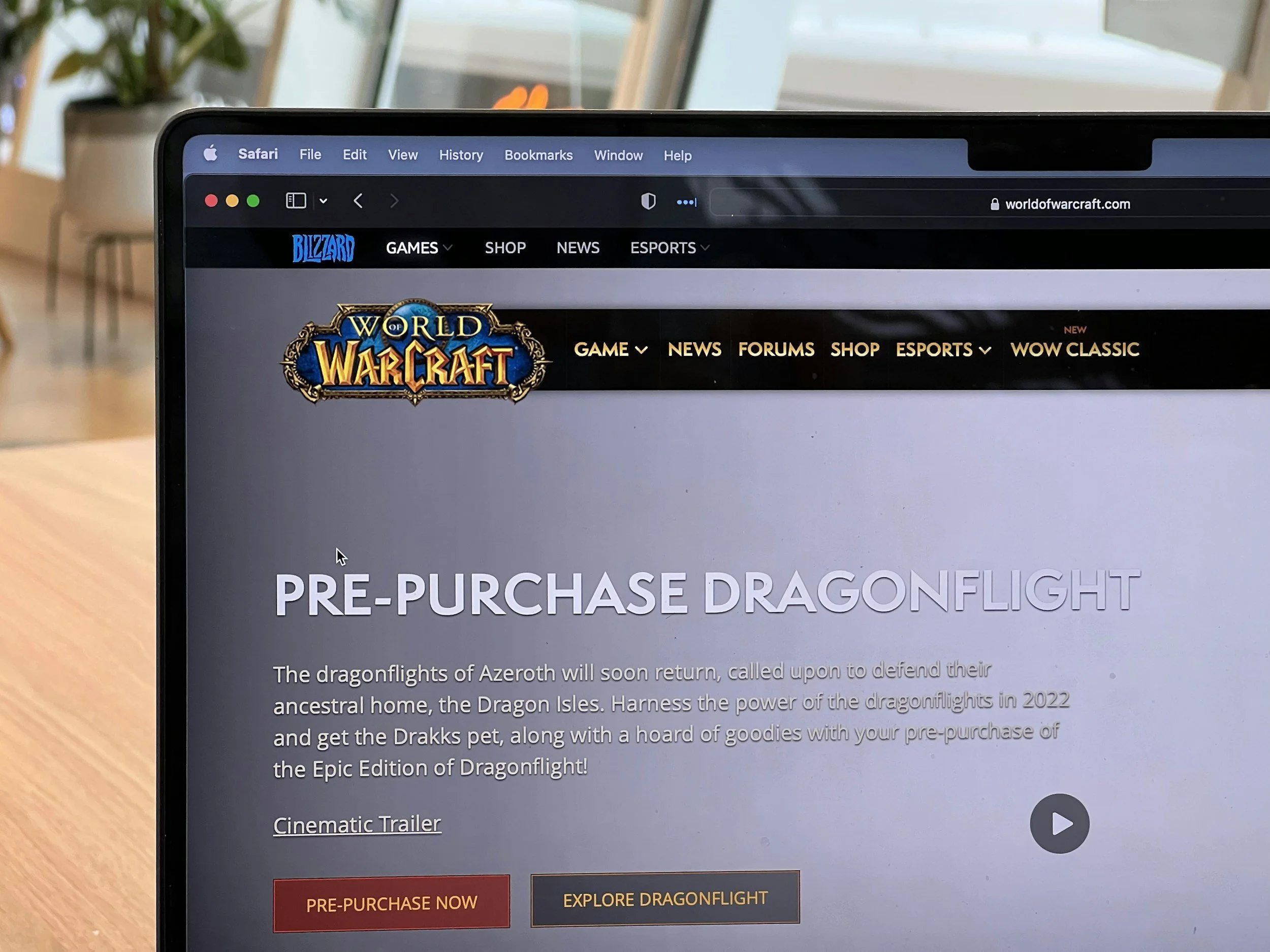
One of the most popular MMORPGs is World of Warcraft (WoW), released by Blizzard Entertainment in 2004. To be able to play, people need to pay a subscription of 12.99€ per month (Blizzard Entertainment, 2022). Despite the fairly high price, WoW reached its peak with 12 million players in 2010 and - according to the latest published company data - dropped to 5.5 million players in 2015 (Statista Research Department, 2016). Despite the drop, 5.5 million people is essentially the population size of Slovakia, so it still makes a very significant number of people interact in one virtual space.
A WORLD TO GET LOST IN
World of Warcraft is set in a fantasy world called Azeroth, full of magic, fights and limitless adventures. Azeroth is inhabited by many races scattered on four continents and islands, has rich lore, culture, its mythology, legends, heroes. At the beginning of gameplay, players choose from two opposing factions struggling for dominance; the Alliance or the Horde. Belonging to a certain faction is determined by a race that the player chooses when creating their character. Races as orcs, trolls or goblins belong to the Horde, and humans, gnomes or dwarfs are from the Alliance. After the race, players have to choose from different classes, for example, mage, warrior or druid. A character’s class predisposes the abilities, powers, skills and spells players will gain through quests and determines the style of gameplay available to that character. Throughout the game, the player also learns and adopts many talents, skills, primary professions (e.g. blacksmithing, jewelcrafting, tailoring) and secondary professions (cooking, first aid, archeology, fishing) (Wowpedia, n.d.). These choices not only provide players with many possibilities of adjusting character to their preferences, individualistic expression, and the way they want to adjust their gameplay but also determine the role in the game as well as in the guild. There are three essential roles for in-game characters in combat: tank, damage, and healer. Each of them has different attributes and responsibilities. Tanks take in damage and prevent others from being attacked, damages are responsible for dealing damage to the enemy and healers keep their co-fighters alive (Wowpedia, n.d.). There are two types of group combats; dungeons and raids. Dungeons are for a party of up to five players and are filled with various enemies. As Runnebreakes describes ‘‘dungeons are admission tickets for raids”. That is because radis are more challenging and designed for a maximum of 40 players. The challenge lies in both the powerful enemies and the ability of the group to think strategically, follow raid leader orders and play as a team. After accomplishing dungeons or raids, players are rewarded with various items and skill points. WoW has no ending goal, rather it lets players explore the world, fulfill quests, improve character, fight in dungeons or raids, and engage with the environment as both, a solo player or in a guild. The definition of a guild is according to the Oxford Dictionary ‘‘medieval association of craftsmen or merchants for a common purpose” (2008, p. 302). World of Warcraft guilds can be easily described in the same manner. Players with different sets of skills and talents form a long-term association for a common goal.
**THE SOCIAL SIDE OF WoW **
World of Warcraft supports various social aspects in its gameplay. In the first place, WoW provides players a variety of emotions and non-verbal signs their character communicates to other players, for example; kiss, cry, nod, clap, wink, etc. (Wowhead, 2019). This way, game designers try to substitute for the lack of FtF communication. By adding non-verbal aspects of daily communications, it makes the game experience more realistic and personal. Next feature are in-game communication channels. Player can either join public chat channels, or create a group chat with in-game friends. Through the public chat, people currently online can communicate, recruit for guilds or exchange goods among each other. Friend based channels serve for less formal activities and general chatting (Wowhead). Certainly, the most important social feature is the existence of guilds. Guilds are a well-appreciated community aspect of WoW that essentially makes people get together, engage with others, and work for a mutual goal. Guilds organize a community of people who, even though they might not know each other FtF, have an opportunity to extend their social ties through CMC. Guilds usually create group-based chat channels through various communication services6. These are used to organize fights, set guild rules, and communication during play but also as a hanging out place for general discussions and talking about personal lives. This way, the guild becomes a place for exchange of information, establishment of new relationships, and in general a core aspect for social life in the game (Taylor, 2006). Despite the disadvantages CMC brings, through playing together, players often strengthen their existing friendships or build new relationships. This is mainly due to the guild's regular interactions, communication, shared space and identity, cooperative environment, mutual support, trust, and contribution to common resources (Ducheneaut, et al., 2006, Nardi & Harris, 2006, Ramirez, 2018). In the light of my interviews, 40% of interview respondents created long-lasting friendships with people they met through guilds, and 60% strengthened their existing relationships.
**UNFORTUNATE GAME STRATEGY: CHANGES IMPACTING THE WoW COMMUNITY **
World of Warcraft heavily supports friendships and cooperation among its players. Besides attractive graphics and many possibilities, this game provides, its most outstanding aspect is its community that players create and spend hours hanging out or fighting within Azeroth. However, in the last few years, Blizzard has continuously changed course from this approach to attract more new players. Whereas before, it was very demanding and difficult to accomplish the final game boss fight – and various other challenges – without being a part of the guild, now the game provides a possibility to find and join a newly formed group. This leaves the player without a need for interaction or communication during fights and can leave right after it is over. This way, the creators wanted to make it easier for new players to experience high-game content, without a need to be a part of a guild. What they achieved instead, is a massive outflow of the player base, which did not like this new feature. Mainly because they feel like it took out the primary element of the game - community, and made achieving challenging tasks easier and less of a community experience. Few interviewees, mainly those who play for long years, summarize these changes and their impacts on the game; While before a player could see only statistics of guilds and see which one is the best – and wanted to join, now there are statistics about each player, which in my opinion makes the game more individualistic. In the past, guild meant that you had people to play with, while now you can play with random people and do not care about the community. In the past, players needed to be a part of guild, otherwise you could not play successfully. (Rjú, 29)
In the new versions of the game, the social aspect is on decline. Now, you just use group finder and it connects you to a formed group. You can make progress without need to speak a word. Before, this was unimaginable. Players had to be a part of the guild and communicate various strategies, roles, teamplay and selection of people for raids. Players now are satisfied after accomplishing the dungeon, but in reality they did not learn anything about strategic thinking, cooperation, or how to improve their character. They care only about the goal, and not the journey (Runebreakes, 20)
**Social Capital and Guilds **
As highlighted in the first chapter, social ties, reciprocity, trust and cooperation represent the main building blocks of social capital. All of the above are also the building blocks of the WoW guilds. Hence, it is interesting to examine the likelihood of building active guild members’ social capital through this virtual online game space.
GUILDS
WoW guilds are mainly formed to make progression in the game easier, and create a social atmosphere. Even though some players can choose solo gameplay without joining guild, it is not usual since guilds can provide players with easier access to end game content7(Taylor, 2006). Guild membership offers various benefits including a sense of community, potential friendships, more in-game opportunities, trading, and exposure to various people who have mastered a certain skill or class and can share their knowledge with others. Guilds can be created by strangers or acquaintances8or by group of classmates or friends9, and their size can vary from a few dozens of people to hundreds. All depends on whether the mutual goal of a guild is focused more socially or on progression.
There are two basic types of guilds; social guilds which highlight personal connections and community, and raiding guilds that are more focused on raids, end game content, progress and achievements (Taylor, 2006). In terms of the interview respondents, 60% of them currently belong to a social guild and 40% to a raid guild. However, 70% have experiences with both. Out of the latter group, every respondent prefered social guilds, mainly because raiding guilds are very demanding and time consuming10. As in every community, a form of hierarchy is present in guilds as well. The most important role is that of a guild master11, who is the main leader and cares about the general organization and the general well-being of the guild. The rest of the leaders hold a position of officers, who fulfill various tasks from organizing raids, recruiting new members or teaching players how to master specific classes. Fifty percent of the respondents had experience with some kind of leadership. In raiding guilds, the leadership is responsible for the management, organization, strategization, and coordination of the members. Raids are the most demanding and complex challenges in WoW, that require teamwork, coordination, cooperation, communication and discipline among the players. To succeed players are expected to fulfill one’s role in the group, help out others and even practise or study their characters (Ducheneaut, et al., 2006). Rjú (29) compares his membership in the raiding guild to a collective sport. ‘‘At the time I did play collective sports, not only esport12, and I remember that I took it equally seriously; trainings, meetings, strategies.. it was fun and a real dedication at the same time”. In social guilds, the leadership organizes raids as well, but the focus is more on the fun along the way rather than progress and success. At any rate, both types of guild form a community from which its members derive social capital benefits. These benefits will be separately discussed later in the chapter13. For players in general, being a part of a guild means that they have constant access to a group of people with whom they can share emotions, thoughts and experiences through hanging out and playing together. For Runebreakes (20), participating in the guild means that ‘‘you can share ups and downs with people. I enjoy that hundreds of people meet at the same place, want to achieve the same goal and live through the same emotions and experiences”. Etysha (21) similarly describes her emotions, ‘‘I am charmed by the fact that dozens of people share and want to succeed in one common goal”. What the interview respondents describe here is a concept of Melucci’s collective identity which is produced ‘‘by several interacting individuals who are concerned with the orientations of their action” (1989, p. 34). After joining a guild, players take on a collective identity which further separates them as a group from others in the game (Ramirez, 2018). Individuals essentially merge their individual identities in a collective one, which creates a feeling of belonging and ‘we
ness’ which further supports social skills and relationships.
As mentioned in the section on the Unfortunate Game Strategy: Changes Impacting WoW Community14, currently it is possible to join dungeons and raids without guild membership. These groups are formed by PUGs (pick-up groups), that randomly select players who want to engage in the same combat. However, every respondent who discussed PUGs dislikes them, and prefers to play with guild members. Runebreakes (20) reflects on the distinction among these; ‘‘It is as if you had to make a decision, whether to go on a trip with friends you trust and know you will have fun, or choose to go with strangers. It might end well, but you will always choose friends”. This metaphor effectively summarizes and supports the sense of the collective feeling in guilds. Collective identity, in social theory described as ‘‘we-ness” by Putnam (Putnam, 2000) is reinforced by cooperation, reciprocity and trust in the community (Thomasello, 2008). Accordingly, in this setting, both individuals and collective derive social capital benefits by their participation (Hyyppä, 2010). In guilds, its members care for each other more, by equating collective identity and shared experiences, mutual tasks and goals, offering help and discussion about their personal lives (Ramirez, 2018).
The above presented arguments indicate that guilds can be perceived as micro-societies of communal units. Even though based on CMC, same as the communities of the offline world, guild members co-exist together in a shared space with an internal organization that is formed for a particular purpose. As in any community, members of the guild are obliged to follow a set of rules and norms, take on various roles, fulfill given tasks, and contribute with resources to the well-being and collaboration of the guild. To put guilds in the light of previously defined social capital concepts: ‘‘the aggregate of the actual or potential resources obtained through membership in a group’’ (Bourdieu, 1986, p. 249), ‘‘social structures that facilitate certain actions of actors within the structure’’ (Coleman, 1988, p. 98) and ‘‘features of social organization, such as networks, norms, and trust, that facilitate coordination and cooperation for mutual benefit” (Putnam, 1993b, p. 35), all three definitions can be applied on a function of the guild. In ‘‘Social Capital in the Creation of Human Capital’’, Coleman (1988), suggests that ‘‘a norm within a collectivity reinforced by social support, status, honor and other rewards, is the social capital that builds young nations'' (p. 104). Through the virtual reality lens, these characteristics do not really build young nations, but definitely create a successful community within a guild.
**RECIPROCITY, TRUST AND COOPERATION IN GUILDS **
Community feeling of guilds in which members cooperate when pursuing dungeons and raids further reinforces reciprocity and trust among players. As already stated, reciprocity, cooperation and trust reinforce each other and that applies for guilds as well.
By joining a guild, players are expected to follow given rules, cooperate, help out others, be responsible and act in good manners. All these are tied to reciprocity, since players expect others to behave according to the norms in the guild. In general, reciprocal behavior in guilds is formed by solidarity, norms, ‘we-ness’, collective action and cooperation (Hyyppä, 2010). One of the guild advantages is that players have a group of people who are willing to help them with leveling a certain class, or on a collective level, access end-game raids. ‘‘Usually, when we lack a healer or a tank, someone creates this character so when it is needed in the future, they can log in and help out. For example, I created a healer which benefited the guild but also myself, considering the lack of healers, I was called for raids more frequently and skilled up faster’’ (Crassula, 25). This is the example of generalized reciprocity15, which is an essential element of building social capital. Members of guilds have also access to a guild bank which allows player to exchange items among players, or store items they do not need for others. ‘‘People in the guild gifted each other with items, despite the fact that they could sell them in an auction’’ (Rjú, 29). Simultaneous mutual exchange of items is considered to be particularized reciprocity16. Following the general definition of reciprocity as ‘‘short-term altruism and long-term self interest’’ (Putnam, 1993a, p. 172), it is definitely enforced in guilds. Rjú (29) remarks that this reciprocal essense of a guild even taught him real-life skills; ‘‘I learnt that when I need something, I can benefit others with something else. For example, when someone shows me how to succeed in a certain dungeon, I can show them how to improve their character. Because trading of items or information is usual in the guilds, it essentially taught me how to negotiate and communicate with people’’. Henceforth, members in the guild exchange items, help out each other and not only exercise but also learn reciprocal behavior.
Although trust in guilds builds over time mainly through daily communication, it simultaneously depends on an individual’s decision to trust Coleman, 1990) and the player’s reputation (Herreros, 2004). Reputation is an essential component of MMORPGs, through which players see players’ skills and level, which further determines gamer’s success, acceptance and position in the guild (Taylor, 2006). This applies primarily to raiding guilds, where players are evaluated to be trustworthy by their character skills, determination, and ability to be responsible or punctual. In raiding guilds, it is very important to prove yourself, and show that you are good enough. Social guilds might consider a player's skill but their behavior is more important. Thus, reputation either in the form of behavior or skill is what influences trust and further cooperation among gamers. As Putnam highlights, trust is not blind (1993a). All study respondents evaluated the player's behavior as the main quality when deciding to trust someone, as well. Half of them were hesitant when asked about trust. They stated that it is difficult to trust someone at first, but they ‘‘decide to trust’’ and expand on it depending on the player’s behavior. Across the interviews, the player's behavior is the main element that supports trustworthiness and enforces cooperation.
You judge people according to their skills and behavior. But when someone has good skills and behaves as an idiot you do not want to play with him. Even though the guild rules stated the priority are good results, in reality, after repeated idiotism these people were quickly kicked out. Afterall, guilds are about building a good community, you cannot play with toxic people several hours a day. (Crassula, 25)
This was interesting to hear, since Crassula is a part of raiding guild and despite the rules, well-being of the community is placed above the success itself. As Runebreakers says‘‘World of Warcraft is essentially about trust. It forces you to trust others because that is the only way to achieve mutual goals’’. Hence, evaluation of trust and further cooperation heavily depends on communication and members' reciprocal behavior; help out others, do not exploit the team, act according to the rules and in good manners.
For guild members, successful cooperation is necessary to defeat dungeons, raids and through positive results build the guild’s reputation in the game. Even though MMORPGs are collaborative by nature, WoW itself does not offer any structure for successful cooperation in guilds (Ducheneaut, et al., 2007, p. 847). The game provides players only with ‘‘cooperative goal structures’’ for example end-game content, ‘‘mechanics and rules that enable support and cooperation’’ – creation of groups and guilds and ‘‘communication features’’ that are in the form of in-game chat channels (Hamari, et al., 2017, p. 181). The success and quality of cooperation depends only on players themselves. ‘‘WoW is essentially set as a real world. Everyone has their own role, needs to cooperate, and contribute for the guild... this then forms the community as a whole’’ (Runnebreakes, 20). In dungeons and raids, each player has their own role (healer, tank or damage), and set of skills that complete each other. Since each character has its own strengths and weaknesses, it is inevitable for a successful combat group to be coordinated well, follow the strategy, be helpful, responsible, use their character’s strength and cover for others’ weaknesses. (Yee, 2006a). Thus, what players expect from each other is reciprocal cooperation based on trust and following rules of tit for tat strategy17. As stated, cooperation is reinforced by coordination, communication, tolerance, trust, ‘we-ness’, norms and continual relations (Axelord, 1984; Putnam 1993a; Thomasello, 2008). However, when the expectations are not fulfilled by some players, they can be easily kicked out from raid, or even a guild. This way guild members rather sacrifice one ‘‘toxic‘‘ member, for the higher good of the guild. As Putnam states, only reciprocal cooperation supported by the decision to trust, further reinforces mutual trust which can resolve in continuing relationships (Putnam, 1993a). Zhi-Jin Zhong, who researched the impact of MMORPG on social capital states; ‘‘Those who take active part in frequent collective play and engage in successful cooperation will enjoy better social capital’’ (Zhong, 2011, p. 2361). Thus, those who are active and took upon a task of a leader, or are active in the guild, are more likely to derive social capital benefits. Zarathyn for example explicitly stated; ‘‘I might have benefited more from the guild if I had more time to be really committed’’(Zarthyn, 20). According to the interviews, 90% of the respondents benefited from social capital through creating new social ties, while 50% benefited by learning various social skills.
**SOCIAL SKILLS **
Social skills can be regarded as benefits that derive from social capital. Naturally, by being a part of some community, people are expected to fulfill given roles and duties, cooperate, be responsible, reciprocal, and when part of the leadership, coordinate, and motivate people. By continual relationships and reinforcement of these ideals, people can develop social or leadership skills that benefit them in real life. In the light of interviews, half of the respondents claimed they obtained or reinforced their social skills by being a part of the guild. Responsible guild leadership can coordinate and motivate members for mutual goals that further resolve into a successful guild. ‘‘The collaboration in MMORPGs can instill community responsibility, give rise to the norms of reciprocity and nourish common interest'’ (Zhong, 2011, p. 2360). Hence, the position of a leader in the guild is very serious and needs to be managed well for guild to prosper. Neroc (24) compares his experience in guild leadership to actual work. ‘‘Imagine you are in the office and have a CEO, that is our guildmaster, and then there are regional managers, who are WoW officers and manage separate branches or tasks’’. This is truly a great example, since guild’s leadership has to deal with various tasks, for example; logistics, strategy, and assigning roles in raids, motivating players, resolving group conflicts, dealing with toxic behavior of individuals, and in general caring about well-being and cohesion in the guild (Yee, 2006a, p. 323). It can be concluded that guild is only as successful as is the leadership, but leadership is as successful as is players cooperative behavior. Guild masters expect following of rules, and cooperation from officers, as well as guild members, and guild members expect quality leadership. Thus, for a successful guild, responsibility, reliability, reciprocal cooperation and trust needs to be established among its members. Four out of five respondents who have an experience with guild leadership, reported that through guild membership, they learnt or reinforced their social skills in real life. However, Crassula who never had a leadership experience, expressively highlights social skills he learned in the guild; When you are a part of a guild like this, you learn how to be good at the game but also as a person. You learn to be assertive, self-confident and active, otherwise, in a guild with 250 members, you will become invisible. When you are active, communicative, and willing to learn and make an effort, then these experiences will transfer to your real life as well. I have been working for half a year, while my coworker for year and a half, and I already earn more money than him. All because I learnt how to be assertive, confident and independent… I learned how to obtain information, arrange things, and deal with or behave in front of people. (Crassula, 25) Crassula is the only respondent, who despite no leadership experience, obtained useful skills he exercises in his personal life. This might be because he was always a member of a raiding guild, which is usually more demanding and as he said, you need to make an effort to be seen as a good player. Apart from him, Neroc (24) had experiences with being both a guild master and an officer. ‘‘I used leadership skills from WoW, in my actual work and even got promoted. Now, I am responsible for managing a branch in a bank’’. While discussing these two cases with academic consultant Tomáš Mališka, he pointed out these benefits are actually tied to Bourdieu’s economic view of social capital. As a result of obtaining social skills from guild membership, Crassula and Neroc got a promotion - advanced economically. Through continual membership in a community that values mainly players' determination, willingness to learn, and cooperation based on reciprocity, both Neroc and Crassula were able to use their skills learned in virtual space, to economic advancement in their personal professional lives. Acquirement or reinforcement of social skills through virtual experiences, was described by the rest of the respondents who have experiences with leadership as well; Etysha (21), Rjú (29) and Runnerbreakes (20). All of them highlighted different sets of skills and benefits they learned in the guild.
I learnt how to present ideas to the public in an understandable way. I also improved my communication with various types of people and practiced how to be patient, tolerant, understandable, and empathetic with others. Also, since you meet a lot of idiots online, you learn how to deal with them offline. I use these skills in my work as a financial adviser as well. (Etysha, 21) Etysha remarks that her social skills can be influenced also by her upbringing, since her mother emphasized her to be kind and understanding with people. However, she admits WoW experience allowed her to practice it, since she is an introvert and does not extensively communicate with people in real life. WoW allowed her to develop her mother’s guidance. In Runebreaks’ case, he also mentioned benefits such as tolerance, patience and not judging people by their appearance. Though through the interview, he mainly highlights benefits he acquired with leadership position; Since I never had an opportunity to be in a leadership position before, it definitely benefited me a lot. Firstly, I realized I am not scared to lead people anymore and am even good at it. I learnt how to organize people and lead them to mutual goals, or resolve their conflicts, how to be patient, tolerable, gain respect, and create a pleasant and inspirative environment for the group. (Runebreakes, 20) Similarly to all mentioned interviewees, Runebreakes learnt how to work with people which he uses in daily interactions and a workplace. Finally, Rjú mainly highlighted benefits that can be considered as direct community benefits of the guild's social capital. I learned how to trust strangers, collaborate, negotiate and be loyal to the common cause. Communal thinking - that things do not belong to me, but to us - is definitely another benefit WoW provided me with. I understood how to be committed and loyal to something, be a part of a community and understand that everyone is dealing with different things in their lives. (Rjú, 29)
Across all answers, it became apparent that each person can obtain a different set of skills through their in-game experiences. Social skills derived from guilds can include leadership, management, people skills or learning how to be a part of a community. Learnt tolerance, patience and communication with people were the most occurring skills players benefited from guild membership. All of the mentioned respondents also expressed that they use in-game obtained or reinforced skills in their daily communication or workplaces. Even though there is a strong correlation between leadership position and obtained skills, participants stated that not only leadership but also membership alone definitely gained or reinforced their social skills.
In his study on experiences of MMORPG users, Nick Yee results also show that these games can indeed have an influence on people’s real life-skills; ‘‘These results are remarkable for MMORPG environments that were not designed to teach leadership skills, and have no structured pedagogical goals or curriculum. But more importantly, these findings demonstrate that real-life skills can be acquired or improved upon in these environments‘‘ (Yee, 2006a, p. 323). Across interviews, Koščo (33) is the only respondent who, despite being in a leadership position, did not report any social skill benefits to his personal life. However, Koščo is the oldest respondent and plays WoW the shortest. While other interviewees have approximately ten years of WoW experience, he joined only a year ago. He even stated that his social skills are primarily derived from work, in which he has to manage and communicate with people. This suggests the positive correlation between years of playing WoW, and acquiring social skills. All players started playing WoW in their early teenage years, and thus might have benefited from being a part of a cooperative, communal environment from an early age. Even though Koščo did not benefit by gaining skills, he states that WoW can be an important place for learning them;
Schools do not teach any management, leadership, social or soft skills. They teach children to be individualistic since everyone has their own grades. However, in WoW, people definitely have an opportunity to learn these skills and then practise various social roles as adults. After all, from childhood we are learning knowledge through games and this is the same. (Koščo, 33)
The topic of learning different social roles from childhood through games was also brought up by my academic consultant, František Gyarfáš. He remarks that playing games decreases as we grow up, and is even considered unacceptable. However, when we decrease our play, we also decrease our ability to fulfill various social roles. My other academic consultant, Juraj Malíček, likewise pointed out that adults who play games are considered to be ‘weirdos’, but MMORPGs can be considered as ‘‘alternatives for education and essentially applied preparation for life’’. He also remarks that games are by default used for recreation, and the true definition of recreation is ‘redefining oneself’. Thus, people are able to ‘redefine’ - learn new social roles, skills and even find out new things about themselves, as in the instance of Runebreaks who learnt he enjoys the role of leadership. All of the presented arguments suggest a conclusion that through virtual shared space, cooperative environments that reinforce trust and cooperation and possibilities of different character customization, guild roles or leadership positions, people are able to benefit by learning to fulfill various social roles and acquire social skills.
**SOCIAL TIES **
For active WoW players, it is essentially inevitable to create either bridging on bonding ties through the guild. Respondents that did not mention social skills as benefit of guild membership, on the other hand, highlighted creating new ties and even years of lasting friendships. Guilds in general, are most often found bridging social ties. However, through daily communication, cooperation based on reciprocity and mutual trust, it is possible that some players eventually strengthen their relationships and create bonding ties. For guilds formed of bonding ties, the same qualities have the potential to strengthen their already established relationships. In the light of my interviews, respondents described three different kinds of social relationships generated through guilds. 1) creation of bridging ties (90%), 2) reinforcement of bonding ties (60%) and 3) transformation of bridging to bonding ties (40%). None of the respondents currently belonged to the strong-tied guild, however, 60% joined the weak-tied guild with someone they knew from the offline world.
Guilds (if not formed by a group of friends) are created from bridging social ties and hence have the potential to create bridging social capital. Through the lens of Putnam’s theory, bridging social networks provides members with ‘we-ness’, collective action, reciprocity and broader information flow (1993, 200). As described in the subchapter regarding Guilds18, all of these are to be found in them as well. Meanwhile, Putnam criticized CMC as not sufficient enough to build social capital, he also mentioned its benefits including connectedness of people from wider backgrounds that provide richer resources of information (2000). These benefits were remarked upon by interviewees as the social network benefits of belonging to the guild. Guild mainly benefited me with a new and broad social network. You can meet different people, which is very useful because you never know who you will meet. It can be an engineer or architect who can help you with building a house in the future. I, as a financial advisor, can for example help people with insurance. (Etysha, 20) Guild indeed exposes you to a wide range of people. ‘’You are introduced to people you would never meet otherwise. It is as if 20 different people from all around the world met in a pub. That would not happen in reality.’ (Neroc, 24). Of course, the expanse of a player's potential social networks depends on whether they join a national or international guild. Out of interviews, 30% were currently in an international guild, while 50% in ‘national’ (Czechoslovak) guild, and two respondents left guild just recently19. According to answers from interviews, the only difference in regards to the quality of bridging social networks was that players from international guilds were also exposed to different races and nationalities of people. However, as Crassula (25) says ‘‘you do not really care about others' nationality, because it does not matter where you are from. What matters is how you behave as a person’’. As mentioned throughout this chapter, when players prove their trustworthiness, continued cooperation and relationships can be reinforced. If players establish these, they are able to benefit from bridging social networks or even create new strong relationships.
Strong ties in guilds are established through continual communication or group play.. It is usual for guild members to exchange conversations while waiting for dungeons or raids. Players talk about the game but also their personal lives (Taylor, 2006). Accordingly, 40% of respondents found long standing friendships which are active until now. ‘‘ I found my biggest sweethearts here, they are the closest people in my life. We have seen each other a few times and even if we do not text for a longer time, when we turn on WoW and join Discord again, it feels as if no time passed. I view them as my brothers ’’ (Etysha, 20). Etysha said these friendships are seven years old, and supported her in difficult times of her life. She also stated; ‘’I definitely have more friends online than in real life’’. Despite being an introvert, she describes herself as more extroverted in guilds, mainly because she feels more relaxed. In this instance, Garrlus (23) who also described himself also as an introvert says; ‘’My job is essentially about communicating and solving problems with strangers. Guild improved my communication skills and thus, it makes my work more comfortable and less stressful’’. This might suggest that for introverts, people with social anxiety or neurodivergent people on the autism spectrum, CmC may allow them to feel less stressed in social interactions since it might be more difficult for them to communicate in the real world. They can derive benefits from social capital in the game. Garrlus (23) as the only respondent admits he feels addicted to the game. However, the reason is not the game itself, but the community he built there. ‘’I have great friends there, one of them is even going to help me move out soon’’ (Garlus, 23). Neroc (25), likewise as Garrlus claims; ‘‘Yes I am addicted, but not to WoW or games, but to the people and community that is in there’’. Through the guild, he established over ten stable friendships, and with four of those lasting for over ten years.‘‘I even am a godfather to one of my guild friends' children’’ (Neroc, 25). Likewise, Etysha (21), Taryska (26) and Garrlus (23), said they found approximately ten good friendships across the years. Due to the community nature of guilds, players are exposed to each other's behavior easily, and depending on their evaluation, further extend their relationships. Despite using CMC, players can create their social networks that are by mutual trust and continual communication transformed into strong relationships. And as in the real world, strong ties can provide players with emotional, social or material support (Coleman, 1988).
The final occurring element, mostly mentioned by the respondents who joined guilds with already existent social ties, refers to shared space and shared experiences. ‘’I have great memories from one summer when I extensively played with my friends. We were discovering the land, fighting in dungeons and raids.. these shared experiences really improved our friendship’’ (Kuroikokoro, 21). Respondents state that they continue to recall memories to each other shared during the gameplay. ‘‘While others talk about their memories from vacation, we recall our adventures and accomplishments in the game. We refer to it as any other experiences from real life.. we share collective emotions and experiences’’ (Rjú, 29). Tarysha, likewise adds; ‘‘It is as when a group of friends meets for a beer, we meet in WoW and go fight in a dungeon’’ (Tarysha, 26). Through collective play, shared virtual space and experiences, players can reinforce their existing relationships. Despite the lack of FtF contact, these recollected memories are as important for friendships as real life memories. To briefly reflect on the ongoing pandemic situation, based on the interview’s descriptions, sustaining friendships through WoW can be regarded as a great substitute for the lack of FtF communication. When questioned about isolation, 70% of interviews confirmed that the community in WoW helped them to satisfy their need for socialization, mainly during lockdowns.
Interviewees' responses seem to confirm the idea that guilds can provide players with both bridging and bonding social ties. Due to the shared space and shared experiences, the communal environment of the guild and the continual communication, its members can create new social relations or reinforce existing ones. Bridging ties acquired through the guild benefit players with a wider scope of resources, due to the range of social networks, unlikely to be created in their personal lives. Bonding social ties, same as in the real world, provide individuals with social as well as psychological support, and of course new close friendships. In addition, it is suggested that guilds can be very beneficial for introverted individuals, who struggle to extend their social capital and learn social skills offline, or as a supplement for social activity in times of ongoing isolation.
**Concluding Remarks **
This case study presents an integrative view of the World of Warcraft long-term associations — guilds, and their members through the sociological and socio psychological point of view. In this study, guilds are analyzed through the lens of social capital theory, which regards trust, reciprocity and cooperation as its main building blocks. The guilds in WoW are following the same fundamental building principles, with addition of regular communication, and common goals. The WoW guilds examined in this study are therefore perceived as micro-societies. The primary question of this thesis asks whether membership in the guilds builds their members’ social capital. Following the results of the self-conducted qualitative research interviews with the Czech and Slovak guild members, it can be concluded that one’s membership in a guild builds an individual's social capital either in the form of obtaining social skills or creating bridging and bonding social ties. Due to the limitations of qualitative research, these findings cannot be presented as general claims. Rather, their aim is to shed light on an individual's experiences, and begin to fill the social research gap in this topic in the region of the Czech and Slovak Republics.
Building on the social capital definitions outlined by Bourdieu, Coleman and Putnam, along with the guidance of Hyyppa’s definition, this study shows the inner dynamics of guilds through the social capital lense. For a better understanding of the concept of social capital and its application onto guilds, the first part of this study delineates its theoretical underpinnings and definitions, explains the key concepts of reciprocity, trust and cooperation as well as the creation and benefits of bridging and bonding social ties, and last but not least, it explores CMC communication. With further support of the interview data, the empirical part of the study examines and analyzes how cooperation, reciprocity, and trust in guilds are reinforced by the regular communication and interaction, common goals, feeling of ‘‘we-ness’’, shared space and shared experiences. The interviewees extensively described their experiences from their guild memberships and reflected on the impacts these experiences have had on their real lifes.
Despite the qualitative research limitations, this study confirmed its hypothesis and brought significant findings into the light. According to the interview responses, while being in a guild, 90% of the respondents created bridging social ties, 60% reinforced
their existing bonding ties, 40% created bonding ties and 50% benefited by learning social skills. Thus, overall 90% of the respondents build their social capital by participating in a WoW guild membership. These contributions demonstrate that, in spite of the negative perception of online video games, playing an online game can bring various benefits to the real life of their players. The findings might suggest that during times when we are not able to build our social capital in the real world, multiplayer online videogames, in this case the WoW guilds, can be viewed as an alternative variant to social participation and social connection. This is especially significant, due to the ongoing pandemic that isolates people and reduces face to face contact. In addition, the WoW guilds can provide a space for the building of social capital for people who struggle with FtF communication such as, introverted people, people with social anxiety or neurodivergent people on the autistic spectrum. For them, CMC communication can be less stressful, more comfortable and thus, in the communal environments of the guilds, they can derive social capital benefits from the game.
Through the lens of social capital, and its main building blocks of reciprocity, trust and cooperation, this study provided applications of sociological theory on the community essence of the WoW guilds. In the empirical part, we at first applied social capital concepts onto the WoW guilds, and then, with the usage of qualitative research interviews, we examined what social capital benefits the guilds can provide to its members. The presented results sketched out a solid ground for future research, which could be organized on a larger scale with a higher number of participants from diverse backgrounds, to increase its reliability. Further on, it would be interesting to investigate the influence of a guild’s membership on the building of social capital of introverts, people with social anxiety or neurodivergent people on the autistic spectrum.
Bibliography Anderson, A., Bruce, V., Garrod, S., Gwyneth, D.-S., Langton, S., & O'Malley, C. (1997). Face to-face and video-mediated communication: A comparison of dialogue structure and task performance. Journal of Experimental Psychology: Applied, 105-125. Aristotle. (1998). Politics. Hackett Publishing Company. Axelrod, R. (1984). The evolution of cooperation. Basic Books. Babbie, E. R. (2014). The Basics of Social Research. Cengage Learning. Bekh, B., Bratz, J. A., Cardoso, C., Ellenbogen, M. A., Frijling, J. L., Kubzansky, L. D., . . . Zuiden, M. v. (2013). The role of oxytocin in social bonding, stress regulation and mental health: An update on the moderating effects of context and interindividual differences. Psychoneuroendocrinology, 1883-1894. Blanchard, A., & Horan, T. (1998). Virtual communities and social capital. Social Science Computer Review, 16(3), 293-307. Blizzard Entertainment. (2022). World of Warcraft. Dostupné na Internete: World of Warcraft: https://worldofwarcraft.com Bourdieu, P. (1986). The Forms of Capital. In Handbook of theory and research for the sociology of education (s. 241-258). Greenwood. Briggs, X. d. (1998). Brown kids in white suburbs: housing mobility and the many faces of social capital. Housing Policy Debate, 177-221. Canny, J., & Nguyen, D. (2009). More than face-to-face: empathy effects of video framing. SIGCHI International conference on human factors in computing systems (s. 423- 432). Boston: ACM Press. Claridge, T. (15. January 2020). Current definitions of social capital. Dostupné na Internete: Soical Capital Research: https://www.socialcapitalresearch.com Cole, H., & Griffiths, M. D. (2007). Social interactions in massively multiplyer online role playing games. CyberPsychology & Behavior, 575-583. Coleman, J. S. (1988). Social capital in the creation of human capital. The American Journal of Sociology, 95-210. Coleman, J. S. (1990). Rational Organization. Rationality and Society, 94-105. Ducheneaut, N., & Moore, R. (2004). The social side of gaming: a study of interaction patterns in a massively multiplayer online game. ACM Conference on Computer Supported Cooperative Work (s. 1-10). ACM Press. Ducheneaut, N., & Moore, R. (2007). Virtual “third places”: a case study of sociability in massively multiplayer games. Computer Supported Cooperative Worls, 129-166. Ducheneaut, N., Moore, R., Nickell, E., & Yee, N. (2007). The life and death of online gaming communities. Procceedings of SIGCHI Conference on Human factors in computing systems (s. 839-848). ACM Press the SIGCHI conference. Ducheneaut, W., Nickell, E., Williams, D., Xiong, L., & Yee, N. (2006). From tree house to barracks the social life of guilds in world of warcraft. Games and Culture, 338-361. Esser, H. (2008). The two meaning of social capital. In The handbook of social capital (s. 22- 49). Oxfor University Press. Fukyama, F. (2000). Social Capital and Civic Society. IMF Working Papers (s. 1-17). International Monetary Fund. Fullwood, C. (2007). The effects of mediation on impression formation: a comparison of face-to-face and video-mediated conditions. Applied Ergonomics, 267-273. Gambetta, D. (1988). Can we trust trust? In D. Gambetta, Trust: Making and Breaking Cooperative Relations (s. 213-237). Gangestad, S. W., & Grebe, N. M. (2016). Hormona systems, Human social bonding and affiliation. Hormones and Behaviour, 1-59. Gardner, A., Griffin, A. S., & West, S. A. (2006). Social semantics: alturism, cooperation, mutualism, strong reciprocity and group selection. Journal of Evolutionary Biology, 415-432. Garnovetter, M. S. (1973). The Strength of Weak Ties. American Journal of Sociology, 1360- 138-. Hamari, J., Maedche, A., Morschheuser, B., & Riar, M. (2017). How games induce cooperation? A study on the relationship between game features and we-intentions in an augmented reality game. Computers in Human Behaviour, 169-183. Herreros, F. (2004). The problem of forming social capital: why trust? PALGRAVE MACMILLAN™. Hyyppä, M. T. (2010). Helthy ties social capital, population health and survival. Springer Science+Business Media B.V. Cherry, K. (28. July 2021). Types of Nonverbal Communication. Dostupné na Internete: verywellmind: https://www.verywellmind.com Korkeila, H. (2021). Social capital in video game studies: A scoping review. New Media & Society, 1-16. Kulynych, J., & Smith, S. S. (2002). It may be social, but why is it capital? The social construction of social capital and the politics of language. Politics&Society, 149-186. Leung, L. (2015). Validity, reliability, and generalizability in qualitative research. Journal of Family Medicine and Primary Care, 324–327. Melucci, A. (1989). Nomads of the present: social movements and individual needs in contemporary society. Hutchinson Radius. Newton, K. (2001). Trust, social capital, civic society and democracy. International Political Science Review, 201-214. Oxford. (2008). Oxford Mini Dictionary & Thesaurus. Oxford University Press. 53 Ozaniaková: Social Capital through the Lens of Virtual Reality Phutela, D. (2015). The importance of non-verbal communication. The IUP journal of soft skills, 43-49. Pinker, S. (2014). The village effect: how face-to-face contact can make us healthier, happier and smarter. Spiegel & Grau. Portes, A. (1998). Social capital: its origins and applications in modern sociology. Annual Review of Sociology, 1-24. Putnam, R. D. (1993a). Making democracy work: civic traditions in modern Italy. In R. D. Putnam, Social capital and institutional success (s. 163-185). Princeton University Press. Putnam, R. D. (1993b). The prosperous community. The American Prospect, 35-42. Putnam, R. D. (2000). Bowling alone: the collapse and revival of American community. SIMON&SCHUSTER. Ramirez, F. A. (2018). Social Interactions in Virtual worlds. In From good associates to true friends: an exploration of friendship practices in massively multiplayer online games (s. 62-79). Cambridge University Press. Statista Research Department. (2. December 2016). Number of world of warcraft subscribers by qurater. Dostupné na Internete: Statista: https://www.statista.com Taylor, T. L. (2006). Play Between Worlds. The MIT Press. Thomasello, M. (2008). Why we cooperate. The Mit Press. Warren, M. E. (2008). The nature and logic of bad social capital. In The handbook of social capital (s. 122-149). Oxford University Press. Wowhead. (1. April 2019). Wowhead. Dostupné na Internete: New Player Guide: Social Features in World of Warcraft: https://www.wowhead.com Wowpedia. (dátum neznámy). Wowpedia. Dostupné na Internete: Wowpedia: https://wowpedia.fandom.com Yao, M. Z., & Ling, R. (2020). ''What is computer-mediated communication? - an introduction to the special issue. Journal of Computer-Mediated Communication, 1-5. Yee, N. (2006a). The demographics, motivations, and derived experiences of users of massively multi-user online graphical enviroments. Presence: Teleoperators and virtual Enviroments, 309-329. Yee, N. (2006b). Motivations for play in online games. CyberPsychology, 772-775. Zhang, S., Anderson, S. G., & Zhan, M. (2011). The differentiated impact of bridging and bonding social capital on economic well-being: an individual level perspective. The Journal of Sociology & Social Welfare, 119-142. Zhong, Z.-J. (2011). The effects of collective MMORPG (massively multiplayer online role playing games) play on gamers' online and offline social capital. Computers in Human Behavior, 2352-2363.