
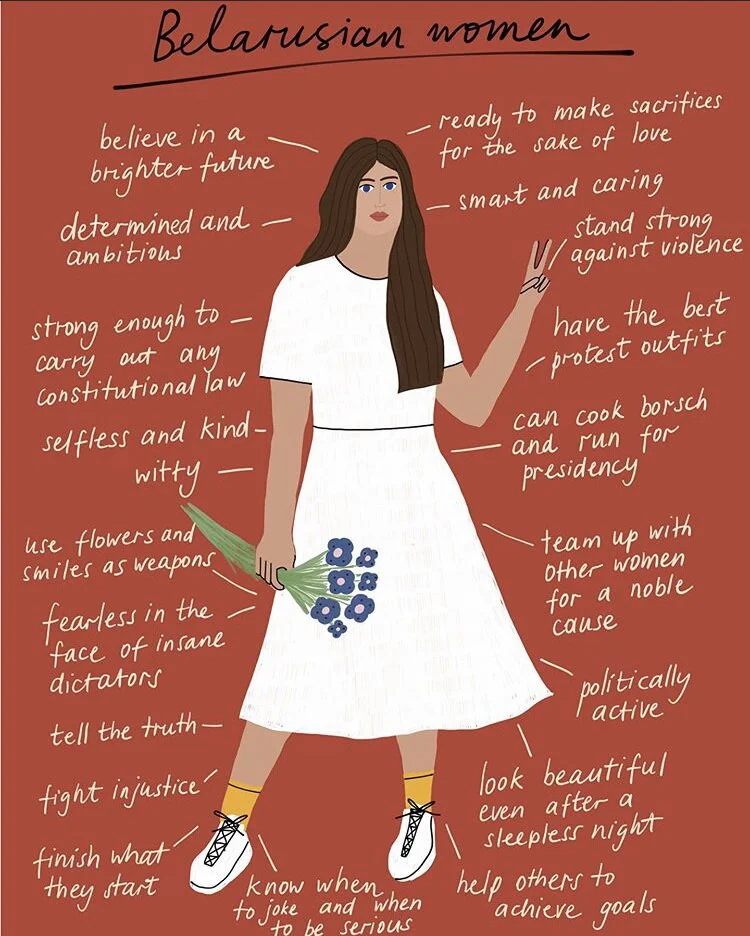
Belarusian women: face of the revolution
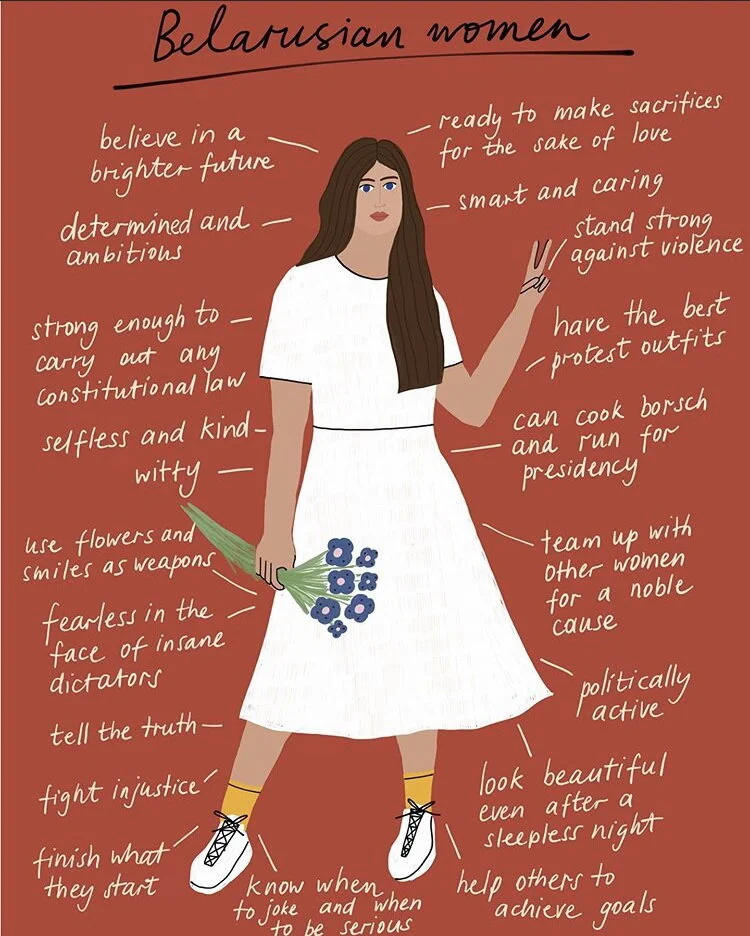
Belarusian women by @olyatikh
Anna Vasilenka / November 22, 2022
(5 min. read)
It's probably high time to write a text about the revolution that has been taking place in Belarus for the past 3 months. I delayed for a long time and did not want to write on this topic, but now my parents and grandparents are fighting the regime there every day under fear of being kidnapped from their workplace or store and put to jail. I decided on this text because I was in Minsk on election day, I went to vote, I ran with my dad through the courtyards from prisoner vans, I ran from bombs, fell asleep listening to the gunshots during the first days after the elections, and I was at the very first nationwide march on August 16.
Now I don’t want to write about the history and background of it, I don’t want to write about all the horrors that are currently taking place on the streets of my country. I decided to approach this text a bit differently and describe one of the phenomena that happened in Belarus during this period of time. The background for this text was the online discussion I attended very recently, the discussion between two teachers from my college in Belarus, who are also the leading feminist philosophers in the country.
Now a little timeline: the presidential elections took place on the 9th of August. On the evening of August 9, 10 and 11 massive protests took place in many big and small cities around Belarus. During those three days, several men were killed, hundreds of people were detained and thousands were beaten by the riot police, the majority of which were men.
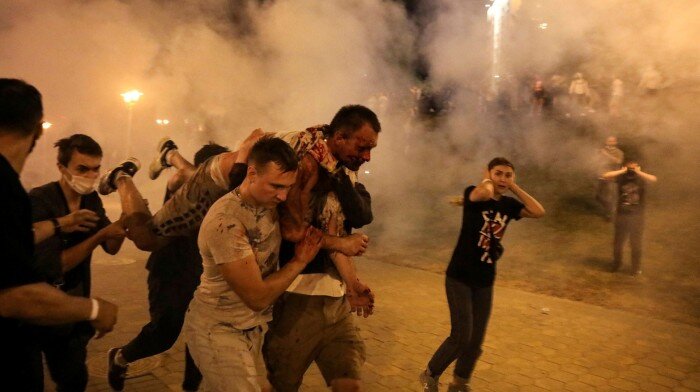
Protesters carry a wounded man during clashes with police in Minsk. Retrieved from FT https://www.ft.com/content/7a695c96-4a51-4b67-bf46-2da526f64b91
On August 12 many mothers and sisters of the detainees gathered in human solidarity chains along the road in solidarity, there was no other way how to express the feeling of injustice and reach the authorities. Those human chains of solidarity continue until today, with not only women but everyone who doesn’t support the regime anymore: students, seniors, the IT sector, doctors, railway workers, workers of major governmental factories, and private businesses.

Women standing in human solidarity chain in Minsk, wearing white clothes and holding white flowers. Retrieved from https://www.zarubejom.ru/news/53967.html
Three months after the presidential elections, I saw a large number of marches of various social groups in the country: a women's march, a march of students, a march of people with disabilities, a march of factory workers, and of course a general march. There is a lot of talk about the women's march as a phenomenon now and a lot of questions are asked, for example, is the women's march a feminist march?
One of the messages of the women's protests is the slogan “If he hits, it means he will be thrown into jail”, which brings to light the harsh detentions and torture of people in Akrestino (local detention centre) during those three August nights. “Abused society” is rather manifested from women, who have always been the weaker sex in society and who are more likely to be subjected to violence than men. Lukashenka holds Belarus, a woman, with his blue hands. There are so many photos and videos of evidence of how Belarusian women protected men from riot police, shielding them with their bodies.
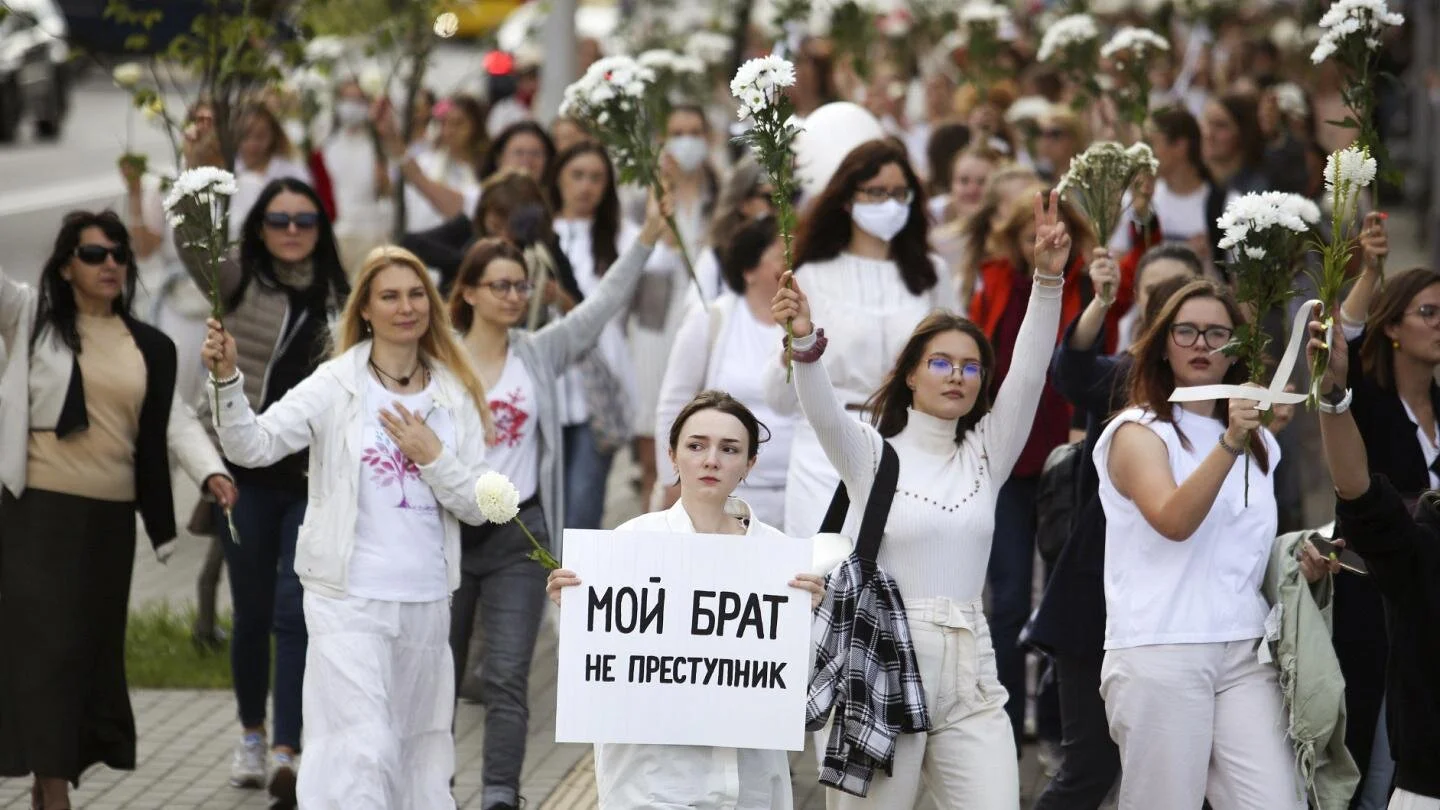
‘My brother is not a criminal’. Retrieved from https://www.euronews.com/2020/08/13/belarus-un-human-rights-chief-condemns-crackdown-as-thousands-of-protesters-remain-in-cust
In addition to the fact that women are considered the weaker sex, it is also said that in the early days of the protests, more men were detained and beaten than women. According to Mediazona [2020], there were 1373 cases of injuries -1316 men and 57 women. The first women's marches on August 12, 13, 14 were held almost without the invasion of the riot police. This testifies to the fact that the president did not regard women as wealthy and independent subjects of society. The political structure in Belarus began to change a month before the elections: the leadership of one man who holds the country in his strong hands passed to three women who entered this struggle out of love for their husbands and respect for their country.
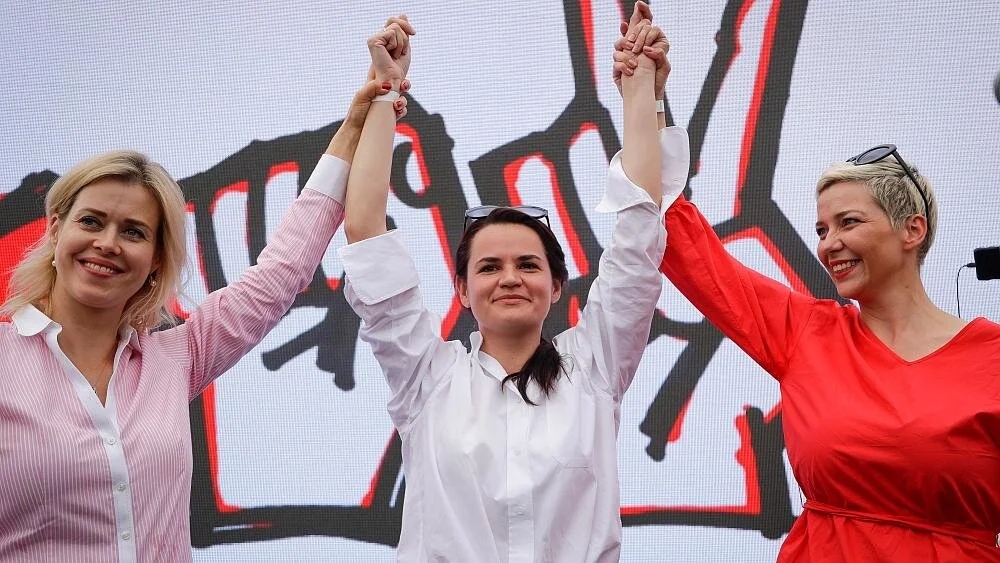
Veronika Tsepkalo, Svetlana Tikhanovskaya and Maria Kolesnikova during their nationalwide rally in Belarus. Retrieved from https://www.euronews.com/2020/07/31/belarus-presidential-elections-meet-the-three-women-teaming-up-to-take-on-europe-s-last-di
Not only women, as a subject, were not perceived by the state, but also grandparents, disabled people, students and schoolchildren. However, it is the women's marches and the strength with which the mothers, sisters, wives and girls of the detained men who go went out, that have such incredible energy.
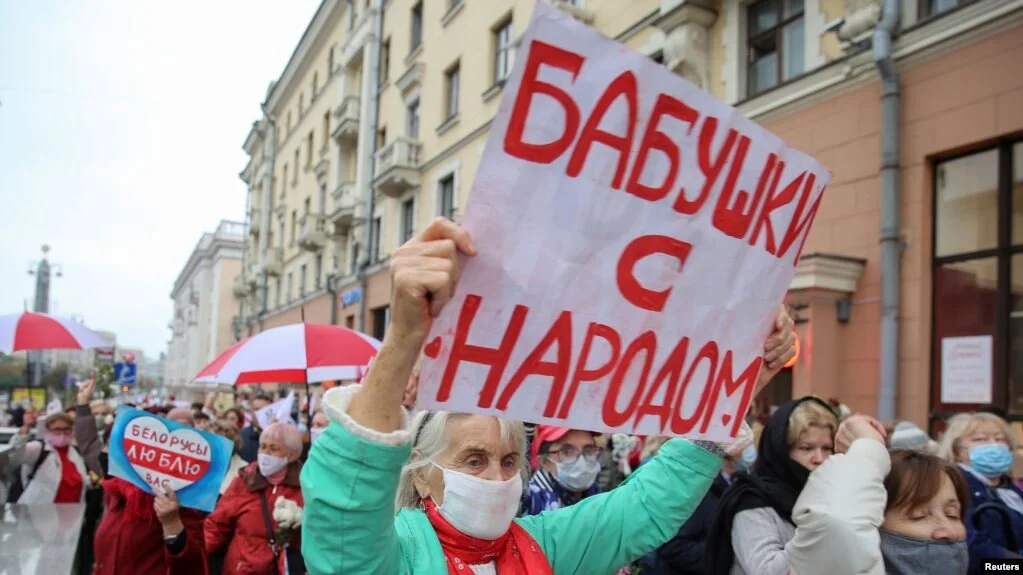
The poster reads "Grandmas with the people." Retrieved from https://www.rferl.org/a/belarus-opposition-leader-calls-on-lukashenka-to-resign-by-october-25/30891201.html
Of course, it doesn't matter if you are a woman or a man, nobody deserves a baton from a riot policeman. At some basic level, a policeman doesn’t want to hurt a woman as much as man, although they do not stop the violence in general. I suppose everything comes from the same beliefs that women are a priori the weaker sex. Yes, women are beaten less, but they have it just as bad as the men. When a man disappears from the street or his workplace, then it is the task of his mother, wife, girlfriend or daughter to find him in one of the prisons, to find out about his condition and charges, to find lawyers, to transfer the necessary things to prison, to live with it, as well to keep going to work and raising the kids. There are no unimportant problems.

A couple hug after being released from a detention centre where protesters were detained during a mass rally following the presidential elections in Minsk, Belarus. August 14. Retrieved from https://www.euronews.com/2020/08/14/in-pictures-protesters-freed-from-detention-centres-in-belarus
It is believed that the women's protests stopped radicalization (those killings and violence against men in prisons in the first days of the post-election protests). On one hand, we do not know if the events would have developed differently and perhaps the authorities would have come to their senses after the publicity of all these events. On the other hand, women's marches (especially those in the early days) greatly changed the very format of the protest. Instead of late at night and the city center, where men usually gathered and immediately came into contact with trained riot police and machine guns, women began to go out in the bright part of the day with flowers in various districts and just stood in human chains, waving their hands to passing cars.
I myself was in one of the first women's chains in Minsk. I remember how I was very much afraid that a prisoner van would come and we would all be beaten up and put in jail. I saw the same fear in the eyes of other girls and how they were afraid to lift flowers up. At the same time, the passing men smiled and supported us, some voluntarily brought us food and water, others bought white flowers (white as a sign of purity, transparency and solidarity). A month before the elections, our national leader Svetlana Tikhanovskaya proposed to wear white ribbons on our arm to make it clear to all people that we are together in this struggle.

‘We are together’. August 13. Retrieved from https://www.nbcnews.com/video/women-in-belarus-march-in-protest-against-police-violence-89995845722
Summing up, I want to say that this (female) protest cannot be called radical or feminist. First, because the first women's protests enabled all social groups in society to be part of this revolution. Secondly, nothing could be more radical than what the Belarusian authorities did on August 9, 10 and 11.
References
Mediazona. (2020, November 3). Brutalised Minsk: how Belarusian police beat protesters. https://mediazona.by/article/2020/11/03/minsk-beaten-en?fbclid=IwAR2h9ATyWqjUE0vZQ7CACWxd44ozvKqNCtoOKoPXKZXzyKSt9JXyGf0B9PM
Маладзёвыя дэбаты ДысКУТ. (2020, October 31). Женский протест. Эффективен ли в Беларуси? [Video]. YouTube. https://www.youtube.com/watch?v=GPuqMHiuDTw&ab_channel=МоладзевыядэбатыДысКУТ